Renaming a D&D Character Mid-Campaign Without Confusing the Table
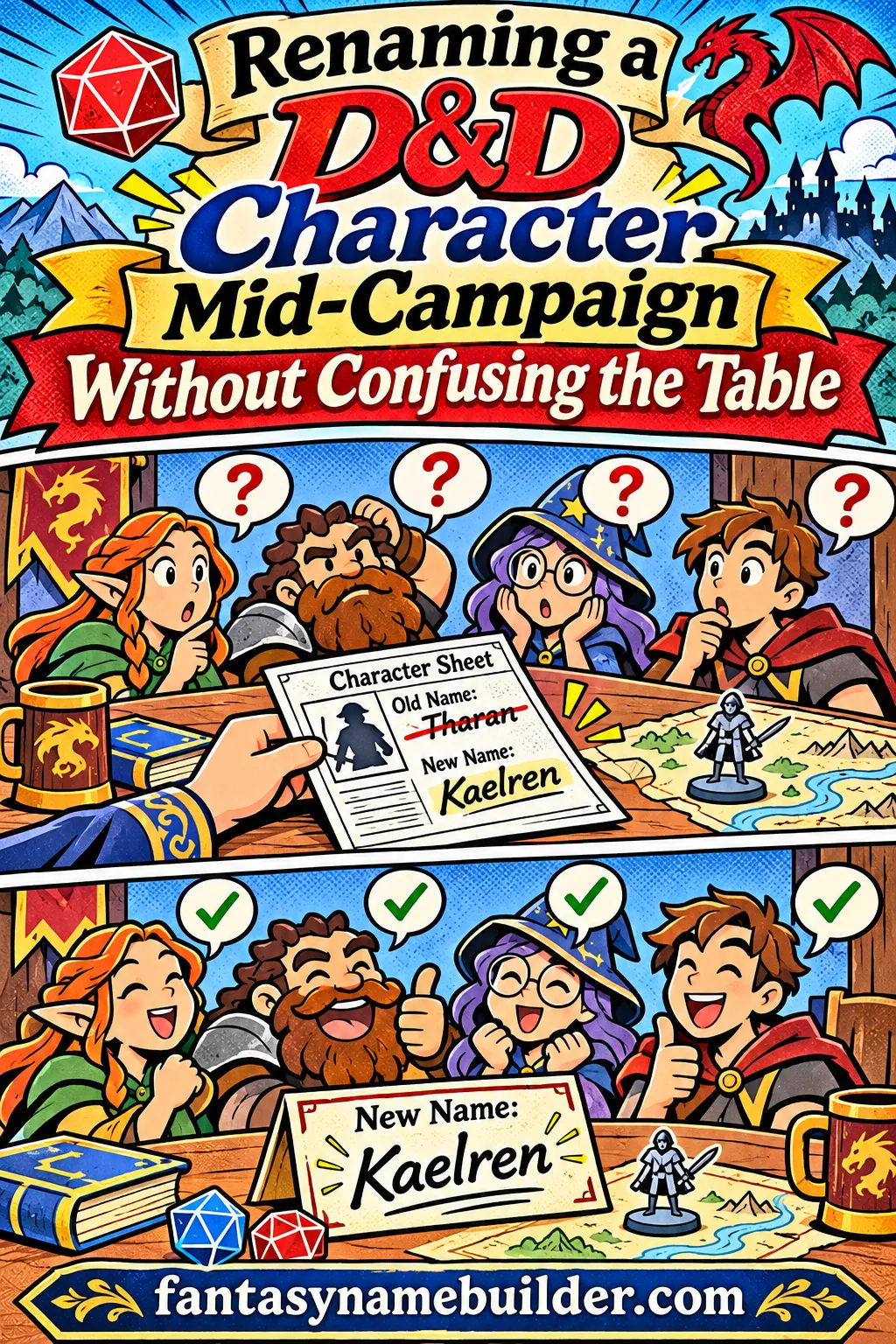
To rename a D&D character mid-campaign, talk to your DM first, agree on an in-game reason for the change (an alias, a title, a true name, a fresh start), and then announce it at the table with a short "formerly known as" period while you update your sheet and notes. That's the whole recipe. The rest of this guide gives you scripts, dozens of story reasons, ready-made names, and a checklist so nobody at the table gets lost. If you need the new name itself, the free Fantasy Name Generator gives you fresh names by race and gender in seconds.
Renaming a character happens more than you'd think. Maybe the name you picked in session one was a joke that stopped being funny. Maybe nobody can pronounce it. Maybe your character's story has grown into something bigger, and the old name doesn't fit who they've become. Whatever the reason, you're allowed to change it. You just want to do it in a way that's fun for the story and easy for everyone else.
⚔️ Pick a name from this list
Tap Next for a name from this page, and save the ones you love.
▶ Generate D&D character names now
Good Reasons to Rename (and When to Wait)
First, a quick gut check. These are all perfectly good reasons to want a new name:
- Nobody can say it. If the table has been calling your character "the elf" for six sessions because nobody can manage Ythrae'lyssandriel, a name change is a kindness.
- It was a placeholder. You picked something fast to get the game started and always meant to come back to it.
- It was a joke. A pun name can be great in a one-shot and wear thin by session twenty.
- It clashes with another name. Two characters named Kael and Kaela in one party is a recipe for confusion. Same goes for a PC who shares a name with a major NPC.
- The character has changed. Your timid apprentice is now a battle-hardened mage. A new name can mark that change.
- It feels too close to something famous. If people keep making jokes about a well-known character from a book or movie, a rename can clear the air.
- It doesn't feel right to you anymore. That's a good enough reason on its own. It's your character.
When might you wait a session or two?
- Right before a big story beat. If the DM has a dramatic reveal planned that hinges on your name, changing it the week before might cause problems. Ask first.
- In the middle of a combat-heavy arc. Name changes land better during downtime, travel, or a quiet scene in town.
- If you're not sure yet. Changing names twice is more confusing than changing once. Take a week to sit with the new name before you commit.
Step One: Talk to Your DM Before the Session
A rename is easy to handle when your DM knows it's coming and messy when it's sprung on them at the table. NPCs, notes, plot hooks, wanted posters, maybe even a prophecy could all be tied to your old name. Your DM needs time to update those, and they may even want to weave the change into the story.
Send a short message a few days before the next game. Here's a script you can copy and tweak:
Hey! I'd love to change my character's name. The old one isn't working for me because [reason]. I was thinking the new name could be [name], and the in-game reason could be [idea, or "I'm open to ideas"]. Is that okay, and would you like to work it into the story or should we just do a quick switch?
That last question matters. Some DMs love a rename because it hands them a story hook. Others would rather keep it quick and move on. Both are fine. Let your DM pick the level of drama.
If you're the DM and a player asks you, here's a quick reply template:
Totally fine! Want to make it a story moment or just a quick update? Either way, I'll change it in my notes. If you want a story reason, I have a couple of ideas: [idea 1] or [idea 2].
In-Game Reasons for a New Name
This is the fun part. A name change can be an invisible fix ("we're just calling him Bram now") or a real moment in the story. Here are story reasons, sorted by how much table time they take.
| Reason | What happens in the story | Table time | Works best for |
|---|---|---|---|
| Quick retcon | The table agrees the character was always called this | None | Pronunciation fixes, typos, placeholder names |
| Nickname that sticks | The party starts calling the character something new | A line or two | Any character, especially after a funny or heroic moment |
| Epithet or title earned | A deed earns a new title ("the Unbroken") | One short scene | Fighters, paladins, barbarians, anyone after a big win |
| Alias or street name | The character starts going by a new name to stay hidden | A short scene | Rogues, spies, fugitives, warlocks hiding a pact |
| True name revealed | A patron, oracle or relic reveals the character's real name | One scene, possibly a plot hook | Warlocks, sorcerers, changelings, foundlings |
| Coming-of-age name | The character reaches a point where their culture grants an adult name | Short ceremony | Elves, dwarves, orcs, tribal cultures |
| Religious or order name | Joining an order or taking vows comes with a new name | Short ceremony | Clerics, paladins, monks |
| Married or adopted name | Marriage, adoption or a blood oath brings a new family name | A downtime scene | Any character with family ties |
| Clan name restored | An exile is welcomed back, or claims a birth name | A story arc beat | Dwarves, nobles, lost heirs |
| Clean slate | After a death, resurrection or betrayal, the character starts over | A dramatic scene | Characters with dark backstories |
| Curse or magic | A curse steals the old name, or a spell alters memory | Possible side quest | Campaigns with fae, hags or memory magic |
| Disguise becomes real | A cover name used on a mission slowly replaces the real one | Gradual, over several sessions | Undercover characters, rogues, bards |
Nicknames and Epithets: The Lightest Touch
If you only want to fix a name that's too long or tricky to say, the easiest path is a nickname. Your character Thandriel Vaelmoorn becomes "Thane," and that's what everyone uses from now on. The legal name stays on the sheet; the table name changes.
An epithet does something similar but adds flavor. After your half-orc survives a fall that should have killed her, the party starts calling her "Bruna the Unbroken," and soon the townsfolk do too. You keep the first name and add a title on the end. If the old first name was the problem, the epithet can replace it entirely: she's just "Unbroken" now.
Aliases and Street Names: Hiding in Plain Sight
Aliases work great for any character with something to hide. Maybe a bounty hunter is closing in. Maybe your noble has fled an arranged marriage. Maybe your rogue just burned down the wrong guild hall. A new name protects them, and it gives the DM a hook: what happens when someone recognizes the old one?
The rogue names list is full of short, sharp names that make good aliases, since they're built to be easy to say and easy to forget.
True Names and Coming-of-Age Names: The Big Moment
For a bigger story moment, a true name reveal is hard to beat. A warlock's patron might finally speak the name it has always called them by. An oracle might reveal that the foundling cleric was born to a fallen noble house. A sorcerer might discover that the power in their blood comes with a name.
Coming-of-age names are a gentler version. In many fantasy cultures, a child name is replaced by an adult name after a test, a journey or a certain age. If your elf or dwarf has just done something that would count, the party could be there for the naming ceremony.
Clean Slates: When the Old Name Carries Baggage
Sometimes a character has done something they want to leave behind, or something has happened to them that changes everything. A resurrection, a betrayal, a lost memory or a faked death can all justify a fresh name. These work best for characters with darker backstories, and they give you great roleplay moments when someone from the past calls out the old name.
How to Pick a New Name That Sticks
You only want to rename once, so it's worth taking a little care with the new name. Run every candidate through these checks.
Easy to say on the first try. Read the name out loud to someone who hasn't seen it written down. If they say it the way you meant it, great. If they hesitate, simplify the spelling or pick another. The whole point of most renames is to get a name people actually use, and people only use names they can say.
Different from everyone else at the table. Look at the other player characters and the major NPCs. Avoid the same first letter as another PC if you can, and definitely avoid the same first sound. If the party already has a Brannoc, skip Bram.
Fits your race and culture. A new name still needs to feel like it belongs to your character's people. An elf's adult name should sound elven. A dwarf restoring a clan name should sound like a dwarf. Even an alias usually fits the region where the character is hiding. For a refresher on how fantasy names are built from sounds and syllables, the guide on how to create fantasy names walks through the basics.
Fits the reason. An alias should be forgettable. A title should be impressive. A true name can be strange and a little mysterious. A coming-of-age name should feel like a step up from the child name.
Short enough for the battle map. If you play online, your name shows up on tokens, initiative trackers and chat. One or two short words fit cleanly. "Rook" and "Ashveil" fit; "Lady Merel of Thornwick, Warden of the Southern Fens" will get cut off.
Has a link to the old name (optional). Some players like a small thread between old and new so the table remembers who's who. A shared sound works well: Thandriel becomes Thane. Kaelyth becomes Lyth. Or keep the surname and change only the first name, which keeps the character's family ties intact.
Here's a quick way to compare candidates:
| Check | Pass | Fail |
|---|---|---|
| Says it right the first time | Varek, Wynn, Sable | Ghyll'thaerys, Xyndrae |
| Distinct from the party | Rook (party: Elorin, Tamsin, Dorn) | Dorran (party already has Dorn) |
| Fits the culture | Elarith for an elf | Gary for an elf (unless that's the joke) |
| Fits the reason | Sable Wend as an alias | Prince Aurelian the Magnificent as an alias |
| Fits a token label | One or two words | Four or more words |
How to Find Your New Name in the Free Tool
The Fantasy Name Generator is a quick way to get a shortlist that already fits your character's race. Here's exactly how to use it for a rename.
1. Pick your character's race. Open the race menu and choose your character's race, such as Elf, Dwarf, Tiefling, Half-Orc or Halfling. If you're not sure where to find it, tap "Browse All Races." For an alias, you might choose the race of the region your character is hiding in instead of their own; a tiefling hiding in a human city might borrow a human name.
2. Set gender. Choose Male, Female, Neutral or Any. Neutral is handy for aliases and disguises, since gender-neutral names attract less attention.
3. Choose length. Short gives you punchy names that fit tokens and are easy to call out mid-combat. Long gives you grander names for titles, true names and noble houses.
4. Choose format. This is where renames get specific:
| Rename reason | Race | Gender | Length | Format |
|---|---|---|---|---|
| Fix a hard-to-say name | Same race | Same as before | Short | First only |
| Alias or street name | Local race of the area | Neutral or Any | Short | Full name |
| True name reveal | Same race | Any | Long | First only |
| Coming-of-age name | Same race | Same as before | Long | First only |
| Married, adopted or restored family name | Same race (or the new family's race) | Any | Long | Surname only |
| Order or religious name | Same race | Same as before | Short | First only (add Brother, Sister or Sibling) |
| Full clean slate | Same race | Any | Short or Long | Full name |
5. Generate and save. Tap Generate ✦, then use the ‹ and › arrows to page through results. Tap ♡ on anything that jumps out. Aim for five to eight saved names.
6. Test your favorites. Open your Saved list and read each name out loud. Then picture the DM saying it as an NPC: "You there, Varek!" Picture the party shouting it in a fight. Cross off anything awkward.
7. Export and share. Tap ⬇ Export .txt and send your top two or three to your DM along with your message. Letting the DM weigh in on the final pick often turns into a great story moment, and it means they've already seen the name before game night.
If you want to browse more widely, the D&D character names page has names sorted by race and class that work well as a starting point too.
Ready-to-Use New Names by Reason
Every name below is original and free to use. Change spellings to match your world.
Aliases and Street Names
These are built to blend in: short, plain, easy to forget on purpose.
- Sable Wend – a reformed thief starting over in a new city
- Ashveil – a one-word name for a rogue who'd rather not explain
- Aldric Thale – a noble traveling as a common merchant
- Jory Fenmarch – a cover name for an undercover investigator
- Mags Corrow – a dockside alias for a fugitive sorcerer
- Tobias Penn – a plain name for a warlock hiding his pact
- Wren Hollis – a forgettable name for a bard on the run
- Kit Daley – an alias that could belong to anyone
- Rook – a hired blade who never gives a full name
- Nell Ashby – a quiet name for a cleric who left her temple
Epithets and Earned Titles
Add these to the character's first name, or let them replace it.
- the Unbroken – survived something that should have killed them
- Stormcaller – called down lightning at the perfect moment
- Bridgekeeper – held a bridge alone against an army
- the Lantern – led the party out of darkness, literally or not
- Two-Fangs – an orc deed-name after a legendary hunt
- Oathbound – kept a promise that cost them dearly
- Ironheart – refused to break under a fiend's interrogation
- the Ashen – walked out of a burning city alive
- Wyrmbane – landed the final blow on a dragon
- Kindhand – known across a region for healing anyone who asked
True Names and Patron-Given Names
Strange, a little old, and sometimes slightly unsettling. A patron or oracle might speak these.
- Oriel Duskmantle – a name a fey patron always knew
- Vaesh – one syllable, spoken only in dreams
- Isembre – the name written in a relic the party recovered
- Thalorien – a sorcerer's birth name sealed by a curse
- Nymara Voss – a foundling's name from a lost noble line
- Caeldris – the true name a fiend uses to bargain
- Elsaveth – the name of a soul reborn in a new body
- Mordaine – a name the character inherits from a dead hero
Coming-of-Age and Cultural Names
- Elarith Moonbough – an elf's adult name after a first century
- Sylvanor – an elven adult name tied to a sacred tree
- Dorn Ashhammer – a dwarf who earns a forge name
- Brenna Ironvein – a dwarf restored to her clan after exile
- Grisk Two-Fangs – a half-orc's first deed-name
- Ilsa of the Red Moon – a tribal name given after a vision quest
- Pell Burrowell – a halfling's family name earned by tradition
Order, Oath and Faith Names
- Brother Hollin – a monk's vow name
- Sister Amity – a cleric's order name
- Sibling Ash – a neutral order name for a paladin
- Warden Corra – a title and name for an oath of the ancients paladin
- Mother Ilse – a respected healer's order name
- Father Ansel – a priest's name taken at ordination
Family, Marriage and Adoption Names
- Kestra Vane – adopted into a family that rescued her
- Wynn Calloway – a half-elf taking her human father's name
- Lady Merel of Thornwick – a title that comes with granted land
- Teo Marchbank – married into a merchant family
- Haldis Stonebrow – a dwarf taking a spouse's clan name
For more family names that match a new house or adoptive family, the fantasy last names list gives you hundreds of options sorted by sound.
Making the Switch at the Table Without Confusion
Your DM has said yes and you've picked the name. Now you want everyone else to actually use it. This is where most renames wobble, because habits are strong. A little setup goes a long way.
Announce It Once, Clearly
At the start of the session, before anyone rolls dice, take thirty seconds out of character:
Quick note: my character is going by [new name] from now on. In the story, it's because [reason]. I'll answer to the old name for a session or two while everyone gets used to it.
That's it. Short, friendly and clear. If the change happens in the story during the session, you can still give a quick heads-up at the start so nobody's confused when the scene arrives.
Use a "Formerly Known As" Period
For the first one or two sessions, say both names together whenever it comes up naturally: "Varek, the one you used to know as Thandor." The DM can do the same in recaps. After that, drop the old name.
It also helps to keep the old name in the story on purpose. NPCs who knew your character before might still use it, which is a great reminder for players and a nice bit of realism. A shopkeeper who calls out "Thandor! Haven't seen you in ages!" helps the table remember the history.
Put the Name Where People Can See It
People forget names they can't see. A few easy fixes:
- Name tent. Fold an index card in half, write the new name in big letters, and set it in front of you. Add a small "formerly [old name]" underneath for the first session.
- Mini or token label. Relabel your miniature's base or your digital token.
- Group chat nickname. If your group has a chat for scheduling, update your display name or pin a short message.
- Recap notes. If someone writes session recaps, ask them to mention the change at the top of the next one.
When the DM Runs the Rename as a Scene
If your DM wants to make it a moment, let them lead. Some ideas the two of you can talk through:
- A naming ceremony in a temple, clan hall or grove, with the party as witnesses
- A herald's announcement at court after a deed earns a title
- A wanted poster with the old name, prompting the character to go by something new
- A dream or vision in which a patron or ancestor speaks the true name
- A party vote where the other players suggest a new nickname and the character chooses one
Party votes are especially fun, because the other players feel invested in the new name and are much more likely to use it.
Tips for Online and Hybrid Games
Online games have a few extra places where names live. Update your token name, your character sheet title, your display name in voice chat, and any macros or roll buttons that print your name. If your virtual tabletop shows names in the initiative order, check that the new one fits without getting cut off.
Tips for New Players and Kids' Tables
New players and younger kids rename characters more often, and that's completely fine. Keep it light. Let them pick from a short list of three names you've pulled from the generator, write the winner on a big name card, and move on. For kids, a nickname-style change ("Everyone calls her Sparks now!") is usually easier to remember than a whole new formal name.
Tips for Organized Play and Shared Campaigns
If your character is part of an organized play program, a convention game or a shared campaign with many DMs, the rules for changing character details can vary. Check with the organizer or the program's official guidance before you change anything on a logged character. In a home game, your DM has the final say.
The Rename Checklist: Update Everything
A name lives in more places than you'd think. Work through this list once, right after the change, and you won't find the old name hiding in your notes three months later.
| Where the name lives | What to update | Who does it |
|---|---|---|
| Character sheet | Name field, plus a note in backstory: "Formerly known as ___" | Player |
| Digital character sheet or app | Character name and any portrait label | Player |
| Virtual tabletop token | Token name, initiative label, roll macros | Player or DM |
| DM's campaign notes | NPC relationships, quest givers, plot hooks that mention the name | DM |
| Campaign wiki or shared doc | Character page title, plus a redirect line from the old name | Whoever runs it |
| Session recaps | A one-line note in the next recap | Recap writer |
| Name tent or mini base | New label | Player |
| Group chat | Display name or pinned message | Player |
| Backstory and journal | Add the in-game reason and the date of the change | Player |
| Inventory and items | Engraved weapons, signet rings, letters or contracts that use the old name | Player and DM |
That last row is easy to forget and can be a lot of fun. An engraved dagger with the old name on it is a perfect thing for a rival to find. A contract signed with the old name might not be binding anymore. Ask your DM if any of these items should change, or if they'd rather keep them as story hooks.
What to Keep From the Old Name
Don't erase the old name entirely. Write it in your backstory notes with a line about why it changed. That way, if a figure from your past turns up, you and your DM both remember what they'd call you. It also keeps your character's history intact for anyone reading the campaign notes later.
Troubleshooting Common Rename Problems
Even with a clear announcement, a few things can go sideways. Here's how to handle them.
| Problem | Why it happens | Easy fix |
|---|---|---|
| People keep using the old name | Habit, especially after many sessions | Keep the name tent out, gently repeat the new name in character, and give it a few sessions |
| The DM forgets in NPC dialogue | The DM is juggling a lot of names | Send a quick reminder before the session and ask them to update their NPC notes |
| The new name sounds like another character's | Didn't check the party list | Swap the first letter, or use a nickname for one of the two |
| Nobody can pronounce the new name either | Fancy spelling | Pick a simpler spelling, or use a short nickname as the everyday name |
| Another player is annoyed by the change | They liked the old name or found it confusing | Talk it out between sessions, and explain why it matters to you |
| The old name was tied to a big plot point | The DM built a story around it | Let the DM fold the change into that plot, or keep the old name as a secret identity |
| You want to change it again | The first pick didn't stick | Talk to your DM, pick carefully, and use a nickname this time to avoid a second full change |
| A joke name became a fan favorite | The table loves it | Keep it as a nickname and use the new name as the formal name |
If You're the DM and a Player Wants to Rename
Say yes unless there's a real story reason not to. Then help the player pick a reason that fits your world, update your notes before the next session, and have one NPC react to the change in the first scene. That single NPC line does more to cement a new name than any amount of reminding.
You might even use a player's rename as a hook. An alias means someone is looking for the old name. A true name means someone else knows it. A title means people expect the character to live up to it. Each of these gives you a story thread for free.
Three Quick Rename Examples
The tongue-twister fix. A player's wood elf, Ythrae'lyssandriel, has been "the elf" for months. The table agrees on a quick retcon: her friends have always called her Lyss. No scene needed. The player updates her sheet, the DM swaps the name in two NPC notes, and play goes on.
The alias with a hook. A human rogue named Davin Marr robs the wrong noble. Between sessions, the player and DM agree he'll go by Sable Wend in the next city. Two sessions later, a bounty hunter arrives asking about a man named Davin Marr, and the whole party has to keep the secret.
The title that replaces a name. A half-orc fighter with a joke name from session one holds a mountain pass alone while the party escapes. The grateful village calls her Bridgekeeper. The player loves it, and from then on, nobody uses the joke name except one cranky old innkeeper who knew her before.
Pick Your New Name Today
Talk to your DM, pick a reason from the table above, and spend five minutes in the free Fantasy Name Generator with your character's race selected. Save your favorites with ♡, export the shortlist, and send it along with your message. By next session, the whole table will be calling your hero by a name that finally fits.
▶ Generate D&D character names now
Frequently Asked Questions
Can you rename a D&D character mid-campaign?
Yes. There's nothing in a typical home game that stops you from changing your character's name. Just talk to your DM first, agree on how it'll happen in the story (or whether it's just a quick fix), and let the rest of the table know at the start of the next session.
How do I explain a name change in the story?
Pick a reason that fits your character: an alias to stay hidden, a title earned from a big deed, a true name revealed by a patron, a coming-of-age name, an order name after taking vows, or a family name from marriage or adoption. If you don't want a story reason, the table can simply agree the character was always called the new name.
How do I tell my DM I want to change my character's name?
Send a short message before the next session. Explain why the old name isn't working, suggest the new name, and ask whether the DM wants to make it a story moment or just a quick update. Giving them a few days lets them update their notes.
How do I get the table to use the new name?
Announce it once at the start of the session, use both names together for a session or two, and put the new name somewhere everyone can see it, like a name tent or your token label. Having an NPC react to the change in the first scene also helps a lot.
Should my new name sound like my old one?
It doesn't have to, but a small link can help people remember who's who. Shortening the old name into a nickname, keeping the same surname, or sharing one sound between old and new are all easy ways to do it.
What's the difference between an alias and an epithet?
An alias is a different name your character uses to hide their identity, like Sable Wend instead of their real name. An epithet is a title added to a name to describe something about them, like "the Unbroken" or "Stormcaller." An alias hides who you are; an epithet tells everyone.
Do I need to update my character sheet?
Yes. Change the name field, add a line in your backstory about the old name and why it changed, and update any digital sheet, token or macro that shows your name. Check items like engraved weapons or letters too.
How can I find a good new name quickly?
Open the Fantasy Name Generator, pick your character's race and gender, choose Short for an easy everyday name or Long for a grand title, and generate. Save five to eight favorites with ♡, read them out loud, and send your top picks to your DM.