Players Walk Into a Random Shop: Fantasy Shop Names on the Fly
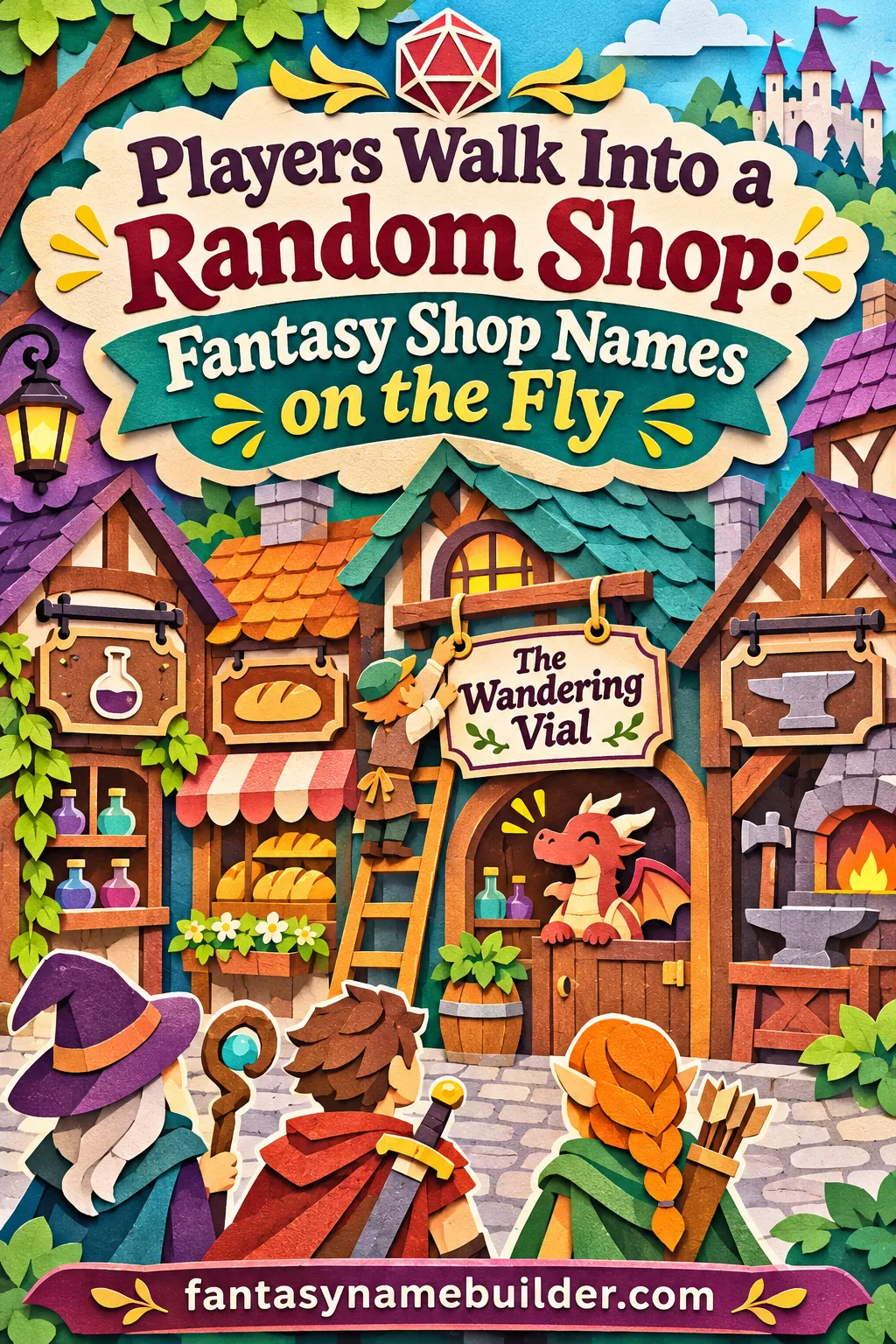
When players walk into a shop you never planned, combine a shopkeeper's surname with a trade word (Ashbellow's Forge, Marrow and Daughter Remedies, The Crooked Lantern Curios) and you have a believable fantasy shop name in under ten seconds. Grab the owner's name from the free Fantasy Name Generator, pick the trade, and choose one of five simple patterns below. The rest of this guide gives you ready-made lists by shop type, a quick shopkeeper kit, and a way to keep every improvised shop so your world stays consistent.
It happens at nearly every table. You prepared the dungeon, the villain and the road to get there, and then someone says, "Before we leave town, I want to buy rope. Is there a shop?" Now five people are looking at you. You don't need a perfect answer. You need a name that sounds like it has always been there, a person behind the counter, and one detail worth remembering. That's it.
This guide is built for that moment. Keep it open during your session or copy the lists into your notes before you play.
⚔️ Pick a name from this list
Tap Next for a name from this page, and save the ones you love.
The 10-Second Shop Name Formula
Every good fantasy shop name answers one question for the players: what can I get here? The best names also hint at who runs the place and what kind of town this is. You don't need to be clever to hit all three. You need a pattern.
Here's the fastest method there is:
- Pick the trade. Smithy, apothecary, general store, tailor, bookseller and so on.
- Grab a name. Open the generator, choose a race that fits your town, set the format to Surname only, and hit Generate ✦. Take the first surname that sounds right.
- Snap them together with a pattern. Surname plus trade word is the default, and it never fails.
So a dwarf smith in a mining town becomes Ironvale's Forge. A human herbalist becomes Corriswell Remedies. A halfling grocer becomes Quickfern's Pantry. Players hear the name, understand the shop, and move on to shopping, which is what they wanted in the first place.
If the surname doesn't fit, hit › to see the next batch, or ‹ to go back to one you liked. You're choosing, not inventing, and choosing is much faster.
Five patterns that cover almost every shop
| Pattern | How it sounds | Examples | Best for |
|---|---|---|---|
| Owner's name + trade | Practical, family run | Ashbellow's Forge, Varnley Tailoring | Smiths, tailors, butchers, most small shops |
| The + adjective + object | Quirky, memorable sign | The Crooked Lantern, The Patient Needle | Curio shops, taverns' neighbors, magic shops |
| Object + object | Old-fashioned trade sign | Anvil and Ember, Quill and Candle | Craftsmen, scribes, chandlers |
| Owner + family word | Generational, settled | Marrow and Daughter, Fletch Brothers | Long-established shops in old towns |
| Place + trade | Local, civic | Riverside Provisions, Northgate Smithy | General stores, markets, guild halls |
Most real-world shops through history were named after their owners or marked with a simple picture sign, because plenty of customers couldn't read. That makes owner names and object names feel the most grounded in a medieval-style world. Clever puns are fun, but use them as seasoning. If every shop in town is a pun, the town starts to feel like a joke.
Say it out loud once
Before you announce a name, say it in your head the way a villager would. "I got it at Ashbellow's" sounds natural. "I got it at The Emporium of Infinite Arcane Wonders" doesn't, and nobody in town would call it that anyway. If a name is long, give it a short nickname the locals use. The sign says The Silver Thimble Tailoring House, but everybody just calls it "the Thimble."
Fantasy Shop Names by Trade
These lists are ready to use as written. Each group has a mix of patterns so you can pick one that matches your town's mood. Mark the ones you use so you don't repeat them in another town.
Blacksmith names
Smithies are the shops players visit most, so they're worth a little character. A smith's name should sound heavy and warm.
| Shop name | One-line hook |
|---|---|
| Ashbellow's Forge | Dwarf smith, family has worked this anvil for four generations |
| Anvil and Ember | Two partners who argue about everything except steel |
| The Hammered Hearth | Doubles as the warmest room in town during winter |
| Northgate Smithy | Shoes the horses of every traveler who comes through the gate |
| Grimmaw Ironworks | Half-orc smith, makes plain gear that never breaks |
| The Red Tongs | Named for the tongs that hang over the door, painted bright red |
| Stonebrew and Sons | Smith and his sons, one of whom secretly wants to be a bard |
| Brightquench Arms | Specializes in blades, polished until they shine |
| The Cold Anvil | The forge went out years ago, and the new owner is restarting it |
| Harrowgate Steel | A former soldier who knows exactly what fails in battle |
| Coalbright Forge | Small village smithy, mostly nails, hinges and plowshares |
| The Iron Kettle | Makes pots and pans, but will grudgingly sharpen a sword |
Want more names with the same heavy, crafted feel? The dwarf names page leans into exactly that sound, and dwarf surnames make strong smithy names on their own.
General store names
The general store is where players buy rope, torches, rations and everything else on the equipment list. These names should feel homey and a little cluttered.
- Corriswell's Provisions – sells a bit of everything and has strong opinions on all of it
- The Full Barrel – known for dried goods, salt pork and travel biscuits
- Riverside Sundries – stocks whatever came downriver on the last barge
- Quickfern's Pantry – halfling owner, the best preserves in three towns
- The Last Stop – the final store before the wilderness, prices to match the risk
- Tallow and Twine – candles, rope and lamp oil stacked to the ceiling
- Wickham Mercantile – formal sign, very informal owner
- The Open Crate – half the stock is still in shipping crates on the floor
- Hollowbrook Goods – the only shop in a tiny farming village
- Two Lanterns Trading – named for the twin lanterns kept burning in the window
- Penner's Odds and Ends – nothing has a price tag, everything is negotiable
- The Waystation Store – serves caravans and travelers on the main road
Apothecary and herbalist names
An apothecary should sound quiet, careful and a little mysterious. Names that mention plants, bottles or remedies tell players instantly that healing potions and herbs are on the shelves.
- Marrow and Daughter Remedies – mother and daughter, one cautious and one bold
- The Green Mortar – named for the giant stone mortar by the door
- Ottlewick's Herbs and Tinctures – the owner talks to her plants, and they seem to listen
- The Willow Cure – a riverside shop known for fever remedies
- Bitterroot Apothecary – everything works, nothing tastes good
- The Glass Vial – rows of colored bottles catch the light in the window
- Thenwood Botanicals – elf herbalist who grows rare plants in the back garden
- The Healing Hand – run by a retired temple healer
- Nightshade and Nettle – sells remedies and, quietly, things that aren't remedies
- Mosswick Physic Shop – old-fashioned, with jars of leeches by the counter
- The Steady Pulse – the place adventurers go before a long trip
- Fernhollow Salves – ointments, poultices and bandages, mostly for farmhands
If your players are about to ask what's actually for sale, the potion names list gives you shelf labels to read out, which makes an improvised shop feel stocked.
Magic shop names
Magic shops are the ones players get excited about, so these names can be a touch more dramatic. Even so, keep them short enough to say twice.
- The Crooked Lantern – curios and minor magic, nothing is quite what it seems
- Starling's Wands and Wardings – a young enchanter trying to prove herself
- The Whispering Shelf – items murmur when customers walk by
- Arcane Sundries – plain name, unusual stock
- The Sealed Door – you have to knock three times and wait
- Moonvault Curiosities – opens only after dark
- The Patient Scroll – scrolls and spell components, sold by an elderly scribe
- Emberline Enchantments – adds small charms to everyday gear
- The Spare Candle – a tiny shop that sells exactly one magic item at a time
- Rook and Rune – run by a wizard and his very opinionated raven
- Thistlewhite Oddments – broken magic items repaired, results not guaranteed
- The Blue Door Emporium – easy to find, hard to leave without buying something
Tailor, leatherworker and armorer names
- Varnley Tailoring – measures customers with a single glance
- The Patient Needle – slow, careful and worth the wait
- The Silver Thimble – the fanciest shop on the street, and it knows it
- Hide and Buckle – leather armor, belts, saddles and boots
- Tanner's Row Leathers – smells exactly like you'd expect
- Fletch and Fletch – sisters who make arrows, quivers and bracers
- The Stitched Shield – patches up armor after every big fight
- Mailcoat Hall – chain shirts hung like laundry from the rafters
- Bramsey Boots – a gnome cobbler who insists on measuring both feet twice
- The Waxed Thread – cloaks and traveling gear made to shed rain
Bookshop, scribe and map seller names
- Quill and Candle – books, ink, paper and a reading corner by the fire
- The Inkwell – a scribe who writes letters for anyone who can pay
- Saltmere Maps and Charts – half the maps are accurate, the owner won't say which half
- The Dusty Margin – used books, many with notes scribbled by past owners
- Hollin's Scriptorium – copies books by hand, three months' wait
- The Last Page – sells only books whose authors are long gone
- The Folded Map – shows the roads, and sometimes the roads that used to be there
- Parchment and Pine – a cozy shop in a forest town
Food shops: bakers, butchers and grocers
- The Rising Loaf – the town wakes up to the smell of this bakery
- Grimmaw's Butchery – gentle owner, terrifying cleaver
- Honeycomb Corner – honey, candles and beeswax goods
- The Salted Ham – cured meats hung from every beam
- Millbrook Flour and Grain – the miller's shop, sells by the sack
- The Sweet Hearth – pastries, tarts and gossip
- Ottlewick Greengrocer – the freshest vegetables, picked that morning
- The Cheese Cellar – down a set of stairs, cold and fragrant
Pawnshop, fence and black-market names
- Harrowgate's Loans and Lost Things – a pawnbroker who never asks questions
- The Second Owner – everything here has had at least one before you
- The Quiet Scale – weighs gold fairly and forgets faces quickly
- Back Door Goods – the name is a joke, mostly
- The Lockless Chest – sells strongboxes, ironically
- Pell's Bargains – the front of the shop is legitimate, the cellar isn't
- Odd Lot Trading – buys anything adventurers drag out of a dungeon
- The Shuttered Window – always looks closed, never actually is
Jeweler, chandler and specialty shop names
- Emberhand Gems – a tiefling jeweler with a fair scale and sharp eyes
- The Cut Stone – appraisals, settings and repairs
- Brannoc's Candles – candles for every purpose, including a few unusual ones
- The Brass Bell – instruments, music sheets and repairs for traveling bards
- Wheel and Spoke – a wheelwright who also builds carts and wagons
- The Tinker's Table – clocks, locks and gnome gadgets, half of them still ticking
- Stonebrew Cooperage – barrels, buckets and strong opinions
- The Painted Mask – costumes, disguises and theater props
- Aldous's Curios – everything comes with a story, and some stories are true
- The Glass Eye – lenses, spyglasses and a few things that see further than they should
How to Make Shop and Shopkeeper Names in the Free Tool
The lists above will carry you through a session or two. After that, you'll want fresh names that match each town, and that's where the free Fantasy Name Generator earns its place on your screen. Here are the exact settings for each job.
Settings for a shopkeeper's full name
- Race: pick the race that runs the shop. If you aren't sure, choose All Races for a mixed trading town.
- Gender: Any, Male, Female or Neutral. Any is fastest when you don't care.
- Length: Short for a gruff, practical owner. Long for a fancy shop or an older, formal family.
- Format: Full name.
- Press Generate ✦ and read the first few names out loud in your head.
- Tap ♡ on any you like. Saved names collect in your Saved list so you can find them later.
That gives you the person behind the counter. A shopkeeper named Durgan Ashbellow already tells the players a lot before he says a word.
Settings for the shop name itself
- Keep the same race so the shop matches its owner.
- Set Format to Surname only.
- Press Generate ✦, then use › to page through until a surname sounds like a sign over a door.
- Add a trade word from the table in the next section.
Surnames that already sound like objects or places, such as Ashbellow, Quickfern or Saltmere, work best because they blend into shop names naturally. If a surname is hard to pronounce, skip it. The players will repeat this name, so it has to be easy. The fantasy last names page is another good place to browse when you want surnames that already sound like they belong on a sign.
Settings for a whole market street
When the party reaches a big city, you may need six or eight shops at once. Do this before the session:
- Set Race to All Races, Length to Short and Format to Surname only.
- Press Generate ✦ and save eight to ten surnames with ♡.
- Switch Format to Full name and save the same number of full names for shopkeepers.
- Press ⬇ Export .txt to download your Saved list as a plain text file.
- Paste that file into your session notes next to the trade words below.
Now you have a market street ready to go, and you can assign shops on the fly as players wander. If they never visit the cobbler, that name simply waits for the next town.
Trade words to pair with any surname
| Trade | Plain trade words | Fancier trade words |
|---|---|---|
| Blacksmith | Forge, Smithy, Ironworks | Arms, Steelworks, Anvil House |
| General store | Goods, Provisions, Sundries | Mercantile, Trading Post, Supply |
| Apothecary | Remedies, Herbs, Cures | Tinctures, Physic, Botanicals |
| Magic shop | Curios, Charms, Wands | Enchantments, Oddments, Arcana |
| Tailor | Tailoring, Cloth, Needle | Outfitters, Silks, Haberdashery |
| Leatherworker | Leathers, Hides, Saddlery | Leatherworks, Tannery |
| Bookseller or scribe | Books, Ink, Maps | Scriptorium, Charts, Bindery |
| Food | Bakery, Butchery, Pantry | Provisioner, Larder, Grocers |
| Jeweler | Gems, Stones, Rings | Jewelers, Goldsmiths |
| Pawnbroker | Loans, Pawn, Trading | Lost Things, Second Hands |
Plain words fit villages and working towns. Fancier words fit wealthy districts and capital cities. That one choice tells players where they are in the world's social ladder without any extra description.
Matching Shop Names to Race and Town
A shop name should sound like it came from the people who built the town. Choosing the race setting in the generator handles most of this for you, but a few habits help the names land.
Dwarf shops sound heavy and proud. They favor the owner's clan name and solid words like hall, works and anvil. Stonebrew Ironworks, Ashbellow Hall of Arms.
Elf shops sound graceful and often describe nature or craft rather than the owner. The Silverleaf Bower, Thenwood Botanicals. An elf may not put their name on the sign at all.
Halfling shops sound cozy and food-friendly. Think Quickfern's Pantry or The Full Kettle. A halfling shop sign might even promise a snack.
Gnome shops sound busy and inventive. Bramsey's Gears and Gadgets, The Tinker's Table. Long, cheerful names fit gnomes better than anyone else.
Half-orc and orc shops sound direct. Grimmaw Butchery. Osk's Blades. Short and blunt reads as honest.
Tiefling shops often lean stylish or a little dramatic. Emberhand Gems, The Painted Mask. It's a nice way to show a character who's built a respectable business despite how others see them.
Human shops cover everything, and they're your default. Use owner's name plus trade most of the time, since it's the most common pattern in human towns.
For the town itself, mood matters more than race:
| Town type | Shop name style | Example |
|---|---|---|
| Farming village | Plain, owner's name, one shop does many jobs | Hollowbrook Goods |
| Mining town | Hard, practical, lots of tools | Coalbright Forge |
| Port city | Sea words, imported goods, trading | Saltmere Maps and Charts |
| Capital city | Formal, fancy trade words, Hall or House | The Silver Thimble Tailoring House |
| Border fort | Military, supply-focused | Northgate Smithy |
| Forest town | Wood, leaf and bark words | Parchment and Pine |
| Rough district | Short, slightly shady, ironic | The Quiet Scale |
The 60-Second Shopkeeper Kit
A shop name gets players in the door. A shopkeeper keeps the scene alive. You don't need a backstory. You need three things: a name, one visible trait and one want.
Step 1: Name
Use a full name from the generator, or the shop's surname plus a first name. Most players will only ever hear the first name, so make it easy to say.
Step 2: One visible trait
Roll a die or just pick one:
| Roll (d12) | Visible trait |
|---|---|
| 1 | Wears magnifying spectacles pushed up on the forehead |
| 2 | Has a cat that sits on the counter and judges customers |
| 3 | Missing two fingers, never explains why |
| 4 | Whistles one song over and over |
| 5 | Covered in flour, sawdust or soot from work |
| 6 | Dressed far better than the shop itself |
| 7 | Very old, very sharp, very slow to make change |
| 8 | Very young, running the shop for a sick parent |
| 9 | Speaks only in short sentences |
| 10 | Keeps a ledger and writes down every customer's name |
| 11 | Has a loud laugh that fills the room |
| 12 | Constantly eating something |
Step 3: One want
| Roll (d8) | What the shopkeeper wants |
|---|---|
| 1 | A rare ingredient or material from somewhere dangerous |
| 2 | News about a missing family member |
| 3 | Someone to scare off a rival who keeps undercutting prices |
| 4 | To sell a strange item that nobody else will buy |
| 5 | To stop paying protection money to a local gang |
| 6 | An apprentice who actually shows up on time |
| 7 | To retire and hand the shop over to someone worthy |
| 8 | Nothing at all, and that's suspicious |
A want turns a shop into a quest hook. Players love buying gear, and they love it even more when the smith says, "I'll knock a little off if you bring me back some ore from the old mine."
A quick example
The party walks into a shop you didn't plan. You glance at your saved list and say:
"The sign over the door reads Marrow and Daughter Remedies. Inside, rows of unlabeled jars line the walls. An older woman named Ilsbeth Marrow looks up from grinding something green. She doesn't label anything, she says, because she remembers it all. Her daughter's been gone three days, gathering herbs in the marsh."
That took under a minute to say, and you now have a shop, a shopkeeper, a trait and a hook. Players will remember Ilsbeth long after they forget the price of a healing potion.
Shopkeeper voices without acting skills
You don't have to do accents. Pick one simple speech habit and stick with it:
- The haggler answers every question with a counteroffer.
- The worrier asks the players if they're sure, every single time.
- The expert explains far too much about how each item was made.
- The gossip trades news for every sale.
- The grump says as little as possible and sighs often.
- The salesperson calls everything "the finest in the realm."
One habit is enough for players to tell shopkeepers apart. If they come back to the same shop next month, use the same habit and they'll recognize the character instantly.
Keep Every Improvised Shop So the World Stays Consistent
The name you invent in a panic tonight becomes canon the moment you say it. Three sessions later, a player will ask, "Can we go back to that apothecary? The one with the lady who didn't label anything?" If you've forgotten her name, the world feels thinner. If you remember, the players feel like the town is real.
You don't need a fancy system. You need a short shop ledger.
A simple shop ledger
Keep one line per shop in your notes. Here's the layout:
| Town | Shop name | Shopkeeper | Trait | Want or hook | Visited |
|---|---|---|---|---|---|
| Hollowbrook | Hollowbrook Goods | Wenna Corriswell | Knows all the gossip | Wants news of her son in the army | Session 3 |
| Hollowbrook | Coalbright Forge | Durgan Ashbellow | Judges you by your boots | Needs ore from the old mine | Session 3 |
| Saltmere | Saltmere Maps and Charts | Corvin Saltmere | Half the maps are guesses | Selling a map he's afraid of | Session 5 |
| Saltmere | The Quiet Scale | Pell Harrowgate | Never asks questions | Owes money to the wrong people | Session 6 |
Write the line during the session if you can, or right after. It takes less than a minute per shop. Over a campaign, this ledger turns into a map of everyone the party has met, and it's one of the cheapest ways to make your world feel connected.
Use the generator's Saved list as a backup
If you tap ♡ on every name you actually use, your Saved list doubles as a record. Press ⬇ Export .txt at the end of each session and paste the file into your campaign notes. That way, even if you forget to write the ledger, you still have every name you spoke out loud.
Recurring shops are worth a second detail
When the party returns to a shop for the third time, it's earned a little more. Add one new detail each visit: the smith's apprentice finally showed up, the herbalist's daughter came home with a strange flower, the pawnbroker has a new lock on the cellar door. Small changes show that life goes on when the players aren't looking.
When Players Ask for Something You Didn't Plan
Shop names are the easy part. The harder moments come when players ask for a shop that probably shouldn't exist, or want to know exactly what's for sale. Here's how to handle the common surprises.
| What the player says | What to do | Example response |
|---|---|---|
| "Is there a magic shop?" in a tiny village | Offer a smaller version instead | "No magic shop, but the herbalist keeps a few odd items in a locked box." |
| "I want to sell this weird artifact" | Send them to a pawnbroker or curio dealer | "Pell at The Quiet Scale buys anything. He'll want to know where it came from, but he won't ask twice." |
| "Who runs the shop?" | Use your next saved full name | "A gnome named Fennick Bramsey, surrounded by ticking things." |
| "What's the shop called?" | Surname + trade word | "Bramsey's Gears and Gadgets." |
| "Do they have a specific item?" | Say yes, no, or "not now, but..." | "Not in stock, but she can order it. Come back in three days." |
| "Can we haggle?" | Let the shopkeeper's speech habit decide | The haggler loves it, the grump refuses. |
| "Is there a rival shop?" | Create one with the opposite style | Across the street from Ashbellow's Forge sits the shiny new Brightquench Arms. |
| "We want to steal from the shop" | Remember the shopkeeper's want | The pawnbroker's cellar was guarded for a reason. |
The phrase "not now, but..." is a DM's best friend. It keeps the world believable, gives the party a reason to come back, and buys you time to decide what the item really costs or does.
Small towns should have fewer shops
It's tempting to give every village a blacksmith, an apothecary, a tailor and a magic shop. Real small communities rarely had that many specialists. A village might have one general store that also sells medicine, one smith who also fixes wagons, and one inn. That's fine. In fact, it's better. Players appreciate the city more when they've spent time in places that can't supply everything.
When a village has only one shop, let its name show that. Hollowbrook Goods sounds like a place that sells everything. The Last Stop sounds like a place you'd better buy from, because there's nothing ahead.
Shops that share a building
Medieval-style towns often packed several trades into one building or one street. You can lean into this. A bakery might share a wall with a candlemaker, so the whole street smells of bread and wax. Shops near a busy inn pick up travelers, which is why it helps to have a few names from the fantasy tavern names list ready for the same neighborhood. A tavern and a shop that share a street can share gossip, rivals and even a family.
Larger cities might organize trades through guilds, where every smith or tailor belongs to the same professional body. If your players start asking who controls prices or who trains apprentices, a guild is your answer, and the fantasy guild names list gives you names that look right carved above a guildhall door.
Mistakes That Make Improvised Shops Feel Fake
Every shop is a pun. One pun shop per town is charming. Five in a row turn the town into a cartoon. Use owner's names and plain trade words for most shops, and save the wordplay for the one quirky place.
Names that are too long. If players can't repeat the name, they'll call it "the sword shop" forever. Keep shop names to two to four words, or give long names a short nickname.
Names that don't say what's sold. A shop called Velmorath tells players nothing. Velmorath's Forge tells them everything. When in doubt, add the trade word.
Same name pattern in every town. If every shop in every town is "Surname's Trade," the world starts to feel stamped out. Change the pattern by region. One town might favor object signs like Anvil and Ember, another might favor family names like Marrow and Daughter.
Forgetting the shopkeeper. A shop name with no person behind the counter is just a menu. Even one trait and one want makes the stop worth remembering.
Reusing a name you already used. It's easy to grab the same favorite twice. A quick look at your shop ledger before you speak prevents two towns from having identical smiths.
Your Prep Checklist Before the Next Session
Take five minutes before you play and you'll never be caught empty-handed again:
- Save 8 to 10 shopkeeper full names in the generator, mixed races, using ♡.
- Save 8 to 10 surnames with Format set to Surname only.
- Export them with ⬇ Export .txt and paste them into your notes.
- Copy the trade words table next to the names.
- Copy the d12 trait table and d8 want table.
- Open your shop ledger so you can add new shops as you go.
- Pick one wildcard shop name, like The Spare Candle or The Sealed Door, for when players wander somewhere unexpected.
That's the whole kit. With it, an unplanned shop takes about as long as rolling a d20.
When you're ready to build a fresh batch for the next town, open the Fantasy Name Generator, pick the race that runs the place, and press Generate ✦. Your players will think you planned the whole street.
Frequently Asked Questions
What are good fantasy shop names?
Good fantasy shop names tell players what's for sale and who runs the place. Examples include Ashbellow's Forge, Marrow and Daughter Remedies, The Crooked Lantern and Quickfern's Pantry. A shopkeeper's surname plus a trade word is the most reliable pattern.
How do I come up with dnd shop names fast?
Use a surname from a name generator, then add a trade word like Forge, Remedies or Goods. Set the generator's format to Surname only, press Generate, and take the first surname that sounds natural. The whole process takes about ten seconds once you've done it a few times.
What are some good blacksmith names?
Try Anvil and Ember, The Hammered Hearth, Northgate Smithy, Grimmaw Ironworks or The Red Tongs. Heavy, warm words like anvil, ember, iron and hearth make a smithy sound right. Dwarf surnames also work well as smith names.
What should I name a general store in a fantasy town?
Keep it homey and simple, such as Corriswell's Provisions, The Full Barrel or Hollowbrook Goods. In a small village, the general store may be the only shop, so a name that sounds like it sells everything fits best.
What are good apothecary names?
Names that mention plants, bottles or cures work well, like The Green Mortar, Bitterroot Apothecary, The Willow Cure or Ottlewick's Herbs and Tinctures. They let players know healing supplies are available before they step inside.
Should the shop name include the shopkeeper's name?
Often, yes. Owner's names are the most natural pattern for small, family-run shops, and they help players remember the person behind the counter. For quirky or magical shops, an object name like The Crooked Lantern can be more memorable.
How many shops should a fantasy town have?
It depends on its size. A small village might have one general store and one smith, while a city might have whole streets of specialists. Fewer shops in small places makes cities feel more exciting by contrast.
How do I keep track of all the shops I make up?
Keep a simple shop ledger with the town, shop name, shopkeeper, one trait and one hook. Tap the heart on names you use in the generator, then export your Saved list as a text file after each session so nothing gets lost.