Fantasy Names With Hidden Meanings That Hint at a Character's Class or Fate
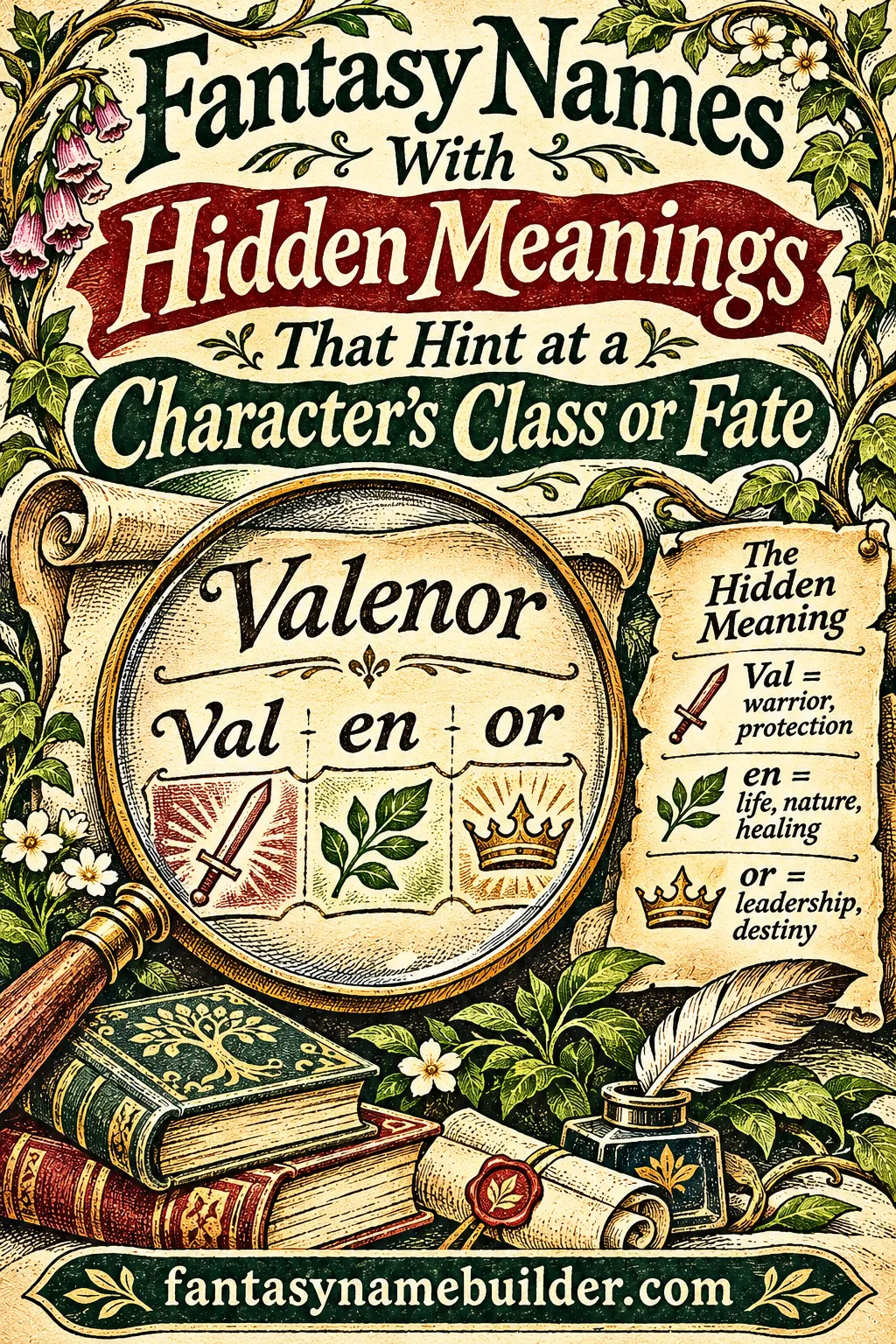
The easiest way to build fantasy names with hidden meaning is to hide one real word from an old language (like Welsh bran, "raven," or Norse eiðr, "oath") inside a name that still sounds natural, so it reads as just a name until someone looks it up. Start with a name that fits your character's race from the free Fantasy Name Generator, then swap in a root that carries the class or fate you want to hint at. Below you'll find root lists by language, nearly 100 ready-to-use names sorted by class and fate, and a step-by-step method for hiding meaning without giving the plot away.
A good hidden-meaning name works on two levels. Most readers or players will never notice anything, and that's the point. The few who do (the friend who looks things up, the player who knows a little Welsh, the reader on a second read-through) get a small, satisfying "oh" moment. That's the effect you're after: a quiet clue, not a neon sign.
⚔️ Pick a name from this list
Tap Next for a name from this page, and save the ones you love.
How Hidden-Meaning Names Actually Work
A name carries meaning in one of three ways. Knowing which one you're using keeps you from overdoing it.
1. A buried root. You take a real word from another language and tuck it inside a longer name. Calondu hides the Welsh calon (heart) and du (black). Read aloud, it sounds like a perfectly ordinary fantasy name. Translated, it says "black heart." This is the most subtle method and the one this article focuses on.
2. A sound echo. The name doesn't contain a real word, but it sounds close enough to one that the meaning leaks in. Thanevra isn't Greek for anything, but the "Than-" opening nudges anyone who knows the word thanatos (death). Echoes are softer than roots, so they're great when you want deniability.
3. An open meaning. The name is plainly a word: Raven, Ash, Vow. That's fine for nicknames and titles, but it's the opposite of hidden. Use it on purpose, for example as an epithet the character earns later, while their birth name keeps the secret.
Most writers mix methods. A character might carry a buried root in their given name, an echo in their family name, and pick up an open-meaning title halfway through the book. That layering is what makes a name feel like it was always meant to be.
The "two out of three" rule
Before you commit to a hidden-meaning name, check that it passes at least two of these three tests:
- It sounds right for the race and culture. An elf name built from Norse roots can work, but only if it still fits the softer sound you've given elves elsewhere in your world.
- It's easy to read. If the root makes the name awkward, like stacking four consonants, the clue isn't worth the stumble.
- The meaning is accurate. You looked up the root in a dictionary for that language, not just a baby-name site or a single online list.
If a name fails two tests, keep the meaning and change the shape, or keep the shape and pick a different root.
Root Words by Language
These roots are real words with commonly accepted meanings. Spellings are simplified where the original uses accents or special letters, and you'll see notes where that matters. Always double-check a root in a proper dictionary for that language before you build a whole plot around it, since many words have more than one sense.
Welsh roots
Welsh is a favorite for fantasy writers because it already sounds otherworldly to most English readers, and many of its words are short enough to drop into a name.
| Welsh root | Meaning | Good for hinting at |
|---|---|---|
| du | black, dark | shadow work, a dark secret, grief |
| gwyn / gwen | white, fair, blessed | healers, holy figures, false innocence |
| coch | red | fire, rage, bloodshed |
| glas | blue, green, gray-silver | sea, sky, calm, coldness |
| bran | raven | scouts, seers, omens of death |
| blaidd | wolf | rangers, outcasts, predators |
| arth | bear | protectors, barbarians, raw strength |
| calon | heart | loyalty, love, betrayal of either |
| seren | star | destiny, guidance, a chosen one |
| nos | night | stealth, sleep, endings |
| tân | fire | sorcerers, zealots, burning out |
| gwir | true | honesty, or ironic lies |
| hen | old | ancient bloodlines, a past life |
| bedd | grave | necromancers, a death foretold |
| aur / arian | gold / silver | wealth, greed, nobility |
| dewr | brave | warriors, or someone faking courage |
| doeth | wise | mentors, sages |
Tip: In Welsh, "w" and "y" are often vowels, and "dd" sounds like the "th" in "this." That's why Gwyn sounds like "gwin." If you want readers to say a Welsh-rooted name the way you hear it, either keep it short or add a pronunciation note in your glossary.
Old Norse roots
Old Norse gives you hard, punchy sounds that suit warriors, raiders and anyone touched by fate. Several letters (ð, þ, ö) don't exist in English. You can keep them for flavor or swap them: ð and þ usually become "th" or "d," and ö becomes "o."
| Norse root | Meaning | Good for hinting at |
|---|---|---|
| ulfr | wolf | rangers, berserkers, lone hunters |
| björn | bear | guardians, warriors |
| hrafn | raven | seers, battlefield omens |
| örn | eagle | leaders, archers, far sight |
| hildr / gunnr | battle | soldiers, someone born to fight |
| sigr | victory | champions, or a costly win |
| eiðr | oath | paladins, oathbreakers |
| galdr | chant, spell | casters who use spoken magic |
| seiðr | a kind of sorcery | witches, hidden magic users |
| rún | secret, rune | spies, scholars, keepers of secrets |
| myrkr | darkness | villains, shadow magic |
| ljós | light | clerics, revelation |
| ís | ice | cold-hearted characters, frost magic |
| eldr | fire | fire mages, fury |
| járn | iron | smiths, unbreakable will |
| draugr | the walking dead | undead, a character already doomed |
| vargr | wolf, outlaw | exiles, criminals |
| frið | peace | diplomats, peace that won't last |
Greek roots
Greek roots show up in a lot of English words, so even readers who never studied Greek may half-recognize them. That makes Greek a little less hidden. Use it for clues you're happy for sharp readers to catch.
| Greek root | Meaning | Good for hinting at |
|---|---|---|
| thanatos | death | doom, necromancy |
| lethe | forgetting | memory loss, a hidden past |
| moira | fate, one's share | destiny, prophecy |
| kleos | glory, fame | heroes, pride before a fall |
| nike | victory | champions |
| sophia | wisdom | sages, advisors |
| aletheia | truth | seers, truth-tellers |
| phos (phot-) | light | clerics, illusionists |
| skotos | darkness | villains, rogues |
| pyr | fire | fire casters |
| lykos | wolf | shapeshifters, rangers |
| pharmakon | remedy, also poison | healers who might be poisoners |
| eleos | mercy | healers, clerics |
| dike | justice | paladins, judges, avengers |
| kratos | strength, power | warriors, tyrants |
| psyche | soul, breath | mediums, soul magic |
Pharmakon is a lovely one for hidden meanings because it means both "remedy" and "poison." A healer whose name hides it carries the whole twist in a single root.
Latin roots
Latin is the least hidden of the four, because so many English words come from it. That's useful when you want a clue that rewards casual readers, too.
| Latin root | Meaning | Good for hinting at |
|---|---|---|
| lux / luc- | light | clerics, saints, false saints |
| umbra | shadow | rogues, assassins |
| mors / mort- | death | doom, killers |
| vita | life | healers, survivors |
| fides | faith, trust | paladins, betrayal |
| ferrum | iron | fighters, smiths |
| nox / noct- | night | thieves, sleep magic |
| cor / cord- | heart | lovers, loyalty |
| sanguis | blood | blood magic, bloodlines |
| corvus | raven | omens, scouts |
| custos | guardian | protectors, wardens |
| fatum | fate | destiny |
| verus | true | honest characters, or ironic ones |
| memor | mindful, remembering | historians, haunted characters |
Old English and Irish roots
Two more short lists, because they blend easily with names your readers already know.
Old English: wulf (wolf), wyrd (fate), hild (battle), sige (victory), mund (protection), helm (protection, helmet), æþel (noble, often written "ethel"), ræd (counsel), wine (friend), niht (night), stan (stone), eald (old).
Irish: dubh (dark, black), fionn (fair, white), ruadh (red), mór (great, big), beag (small), cú (hound), bran (raven), tine (fire), solas (light), anam (soul), croí (heart), bás (death), laoch (hero, warrior), draoi (druid).
Irish spelling and sound often don't match the way English readers expect, so a root like croí (roughly "kree") may be read wrong. That can be a feature: the hidden meaning stays hidden because nobody connects the spelling to the word.
Names That Hint at a Character's Class
Every name below is original and built from the roots above. The note after each name tells you which root it hides, so you can keep the logic straight in your own notes. Feel free to change endings to fit your world's sound.
Warriors, fighters and barbarians
- Hildmar – Norse hildr (battle): a soldier who's never known peace
- Gunnveig – Norse gunnr (battle): a shield-bearer born on a battlefield
- Ferrance – Latin ferrum (iron): a fighter who never bends
- Kratheon – Greek kratos (strength): a champion who leans on muscle
- Arthwen – Welsh arth (bear) + gwen (blessed): a gentle giant
- Nosarth – Welsh nos (night) + arth (bear): a night-watch guardian
- Bjornalt – Norse björn (bear): a barbarian who protects his clan
- Jarnulf – Norse járn (iron) + ulfr (wolf): an iron-willed hunter
- Dewrion – Welsh dewr (brave): a warrior who's secretly terrified
- Sigrunna – Norse sigr (victory) + rún (secret): a winner with a hidden cost
- Laochra – Irish laoch (hero): a fighter destined for songs
- Hildreth – Old English hild (battle): a mercenary captain
Rogues, spies and assassins
- Umbrel – Latin umbra (shadow): a cutpurse who's hard to spot
- Skotiel – Greek skotos (darkness): an assassin raised in secret
- Runavel – Norse rún (secret): a spy who trades in whispers
- Dubhán – Irish dubh (dark): a thief from the back alleys
- Noctira – Latin noct- (night): a cat burglar who works after dark
- Duvessa – Welsh du (black): a smuggler with a black-market past
- Myrkell – Norse myrkr (darkness): a killer-for-hire
- Gwirion – Welsh gwir (true): a spy named "true," which is the joke
- Vargren – Norse vargr (wolf, outlaw): a criminal on the run
- Fallaxa – Latin fallax (deceptive): a con artist in plain sight
- Nosdren – Welsh nos (night): a burglar who loves moonless nights
- Corvane – Latin corvus (raven): an informant who collects secrets
Wizards, sorcerers and mages
- Galdrik – Norse galdr (chant): a mage who speaks spells aloud
- Seiðra (or Seithra) – Norse seiðr (sorcery): a witch hiding her craft
- Pyrrhen – Greek pyr (fire): a fire caster with a short temper
- Tanwen – Welsh tân (fire) + gwen: a blessed flame-wielder
- Ignara – echo of Latin ignis (fire): a sorceress who burns too bright
- Psychael – Greek psyche (soul): a mind or soul mage
- Sophiren – Greek sophia (wisdom): an archmage's apprentice
- Lethiel – Greek lethe (forgetting): a wizard who erases memories
- Isgard – Norse ís (ice): a frost mage, cold in every sense
- Runhild – Norse rún + hildr: a battle mage who carves runes
- Eldrun – Norse eldr (fire) + rún: a fire-rune scholar
- Doethan – Welsh doeth (wise): a hedge wizard others underrate
For more spellcaster naming patterns, the wizard names page has dozens of ready-made options you can then "salt" with a root.
Clerics, paladins and healers
- Lucaria – Latin luc- (light): a cleric who may not be as pure as she seems
- Fidelan – Latin fides (faith): a paladin whose faith will be tested
- Eiðra (or Eithra) – Norse eiðr (oath): a knight sworn to a dangerous vow
- Dikaron – Greek dike (justice): a judge-paladin
- Eleona – Greek eleos (mercy): a healer who forgives too easily
- Pharmara – Greek pharmakon (remedy or poison): a healer with a poisoner's past
- Gwynnor – Welsh gwyn (blessed, white): a priest of a pale god
- Vitalis – Latin vita (life): a field medic who refuses to lose anyone
- Solasa – Irish solas (light): a lantern-bearing cleric
- Ljosmund – Norse ljós (light) + Old English mund (protection): a holy guardian
- Custavel – Latin custos (guardian): a temple warden
- Anamel – Irish anam (soul): a priest who tends the dying
Rangers, druids and scouts
- Ulfrena – Norse ulfr (wolf): a ranger who hunts alone
- Blaiddyn – Welsh blaidd (wolf): a tracker raised by wolves
- Lykarion – Greek lykos (wolf): a ranger with a beast form
- Brannoch – Welsh bran (raven): a scout who sees too much
- Hrafnel – Norse hrafn (raven): a druid who speaks with crows
- Ornvald – Norse örn (eagle): an archer with perfect sight
- Coedwen – Welsh coed (trees, woods) + gwen: a forest druid
- Draoiche – Irish draoi (druid): a keeper of old groves
- Glasyn – Welsh glas (blue-green): a druid of rivers and moss
- Cúlan – Irish cú (hound): a beast-master with a loyal dog
Bards and diplomats
- Kleomene – Greek kleos (glory): a bard who wants to be famous
- Fridlauga – Norse frið (peace): an envoy whose peace treaty fails
- Rædwine – Old English ræd (counsel) + wine (friend): a royal advisor
- Aletha – Greek aletheia (truth): a singer who can't tell a lie
- Calonna – Welsh calon (heart): a minstrel with a broken heart
- Memorin – Latin memor (remembering): a historian-bard
Names That Hint at a Character's Fate
Class hints tell readers what a character does. Fate hints tell them what happens to the character. Treat these with care: a fate hint is a promise, and readers who decode it will expect you to keep it (or to break it on purpose in a satisfying way).
Death, doom and sacrifice
- Thanevra – echo of Greek thanatos (death): a healer fated to fail
- Morticai – Latin mort- (death): a hero who won't survive the war
- Beddwyn – Welsh bedd (grave) + gwyn: a blessed grave, a noble death
- Basira – Irish bás (death): a gentle character marked for loss
- Draugin – Norse draugr (walking dead): someone who comes back wrong
- Moirenne – Greek moira (fate): the one who ends the story
- Wyrdith – Old English wyrd (fate): a girl caught in a prophecy
- Fatira – Latin fatum (fate): an heir with a foretold role
- Seirwen – Welsh seren (star) + gwen: a doomed chosen one
- Hendu – Welsh hen (old) + du (dark): an old evil reborn
Betrayal and hidden villains
- Calondu – Welsh calon (heart) + du (black): a hidden traitor
- Fidessa – Latin fides (faith): a trusted friend who betrays the party
- Vargeth – Norse vargr (outlaw): a loyal knight who becomes an outlaw
- Myrkwen – Norse myrkr + Welsh gwen: a "blessed darkness," a smiling villain
- Skotara – Greek skotos: a mentor with a shadowed heart
- Lucumbra – Latin luc- (light) + umbra (shadow): someone torn between sides
If your story needs a full antagonist, pair one of these with ideas from the villain names list so the hidden root sits inside a name that already sounds menacing.
Redemption and rising
- Ljosvarg – Norse ljós (light) + vargr (outlaw): an outlaw who turns hero
- Duwen – Welsh du (dark) + gwen (blessed): a dark past, a blessed ending
- Umbralux – Latin umbra + lux: from shadow to light (open, so use it as a title)
- Sigrel – Norse sigr (victory): someone who finally wins
- Vitanox – Latin vita (life) + nox (night): life after the long night
Lost memory, hidden identity, secret heirs
- Lethwyn – Greek lethe + Welsh gwyn: a forgotten royal
- Henarian – Welsh hen (old) + arian (silver): an heir to old silver blood
- Runelle – Norse rún (secret): someone who doesn't know who she is
- Memoria – Latin memor: a character who remembers past lives
- Aethelin – Old English æþel (noble): a commoner with a hidden noble line
- Sanguera – Latin sanguis (blood): a bloodline that matters to the plot
Love, loyalty and broken vows
- Croíana – Irish croí (heart): a romantic lead
- Eiðvald – Norse eiðr (oath): a sworn protector who breaks his vow
- Cordelan – Latin cord- (heart): a loyal friend to the end
- Winewen – Old English wine (friend) + Welsh gwen: a beloved companion
- Calonseren – Welsh calon (heart) + seren (star): star-crossed love
That's nearly a hundred ready names. If you want hundreds more starting points with the right racial sound, generate a batch first and then "salt" a few of them with roots, as shown in the next section.
How to Make Hidden-Meaning Names in the Free Tool
You don't need to invent every syllable yourself. The quickest workflow is to let the Fantasy Name Generator give you names that already sound right for a race, then tuck a root inside the best one. Here's exactly how.
Step 1: Pick the race and settings
On the generator's homepage, set:
- Race: the character's race (for example Elf, Dwarf or Human), or All Races if you're still deciding. Use "Browse All Races" to see the full list.
- Gender: Any, Male, Female or Neutral. Neutral is handy for roots like rún or seren that suit anyone.
- Length: Short if you'll be adding a root (it gives you room to grow), Long if you'll be swapping a syllable out.
- Format: First only while you're experimenting. Switch to Full name or Surname only later if you also want a family name that carries a clue.
Then press Generate ✦.
Step 2: Page through and save candidates
Use the ‹ › arrows to page through batches. Don't hunt for the perfect name yet. Instead, look for names that have a syllable you could swap out, or a sound that's close to one of your roots. Tap ♡ to save each candidate to your Saved list. Ten to fifteen saved names is plenty.
Step 3: Match a root to each candidate
Look at your saved names next to the root tables. You're hunting for overlaps:
- A generated name that starts with "Bra-" is one letter away from Welsh bran (raven).
- A name ending in "-dren" or "-dra" can become "-du" or "-dubh" for a dark hint.
- A name with "Hel-" or "Hil-" can lean toward Norse hildr (battle).
- Names starting with "Lu-" already brush against Latin lux (light).
If a candidate doesn't overlap with anything, don't force it. Move to the next one.
Step 4: Rebuild the name
Swap a syllable, add a root to the front or back, or blend two roots. Keep the generator's ending if you can, because the ending is usually what makes a name feel elven, dwarven or human. For example, an elven-sounding name ending in "-iel" keeps that ending while the front changes to Leth- (forgetting), giving you something like Lethiel.
Step 5: Export your shortlist
When you've got four or five finalists, use ⬇ Export .txt to download your Saved list. Add the root and meaning next to each name in your notes so you remember why you chose it six months from now.
How Hidden Should the Meaning Be?
Not every clue should be equally buried. Decide how many readers you want to catch it, then pick a technique to match.
| Subtlety level | Technique | Who notices | Example |
|---|---|---|---|
| Almost invisible | Root from a less familiar language, respelled | Only readers who look it up | Calondu (Welsh, "black heart") |
| Quiet | Root kept close to its original spelling | Readers who know a little of the language | Hrafnel (Norse hrafn, raven) |
| Noticeable | Greek or Latin root that echoes an English word | Many attentive readers | Lucaria (light), Morticai (death) |
| Obvious | Plain English word or open translation | Everyone | Raven, Oathbreaker |
A useful rule of thumb: the bigger the twist, the deeper you hide the clue. A traitor's name should sit in the "almost invisible" row, because if readers decode it in chapter one, the betrayal won't land. A paladin's name can sit in the "noticeable" row, because "she's faithful" isn't a spoiler. It's characterization.
Spreading the clue across a full name
You can also split a meaning between a given name and a family name, so neither part gives it away alone. For example:
- Seren Calondu – "star" plus "black heart": a chosen one who turns dark
- Brannoch Hendu – "raven" plus "old darkness": a scout descended from something evil
- Eleona Pharmara – "mercy" plus "remedy/poison": a healer whose mercy kills
To find a family name that sounds right before you add a root, set the generator's format to Surname only, or browse fantasy last names for patterns like "-holt," "-mere" and "-vane" that you can attach to a root.
Checking Translations Before You Commit
Hidden meanings fall apart if the meaning is wrong. A few habits save you from embarrassing mistakes.
Use a real dictionary for that language. Baby-name sites are a fine starting point, but they often give a single poetic meaning for a word that has several plain ones. Check the root in a dictionary or a reputable language-learning reference. For older forms like Old Norse or Old English, look for a dictionary of the historical language, since modern Icelandic or modern English may have shifted the meaning.
Check the whole name, not just the root. Once you've blended two roots, the finished name might accidentally spell a different real word in another language. Search the finished name on its own to make sure it isn't a slang term, a brand, a real place or a famous character.
Watch for living cultures. Welsh and Irish are living languages with real speakers. Borrowing a root is common practice in fantasy, and it's usually received well when you treat it with respect. Avoid using sacred or culturally significant terms as throwaway villain names, and be careful with names of real deities or saints.
Keep a naming file. Write down each name, its root, the language, the meaning and where you checked it. This sounds tedious, but it's the difference between a clue you can explain to a curious reader and one you can't remember making.
Don't trust a single machine translation. Automatic translators are built for modern sentences, not single ancient words. They'll often give you a modern word that never existed in the older language, or pick the wrong sense of a word with several meanings.
Four Worked Examples
Seeing the whole process start to finish makes it easier to do on your own.
The traitor in the party. A writer needs a cheerful half-elf companion who betrays everyone in act three. They generate half-elf names, save one that starts "Calo-," and notice it's one letter from Welsh calon (heart). They add du (black) to the end, getting Calondu. It reads as friendly and musical, and nobody but a Welsh speaker will catch it. For more half-elf sounds, the half-elf names page is a good place to start.
The healer who poisons. A game master wants an NPC herbalist whose remedies are slowly killing the village. They pick Human, Female, Short, First only, generate a page, and save a name starting "Phar-." They shape it into Pharmara, hiding Greek pharmakon, which means both remedy and poison. When players finally solve the mystery, the name is the cherry on top.
The chosen one who dies. A novelist wants a hero whose death is foretold but not spoiled. They blend Welsh seren (star) and gwen (blessed) into Seirwen, which sounds hopeful. The "blessed star" meaning reads as destiny on the surface, and only on reread does it look like a falling star.
The wolf who stays loyal. A player building a ranger wants a name that hints at a wolf companion without being called "Wolf." They choose Norse ulfr, generate Elf names with Neutral gender and Long length, and blend the root into a flowing elven shape: Ulfrena. The hard Norse root softens with the elven ending, which also hints that the ranger was raised among another culture.
Common Problems and Fixes
| Problem | Why it happens | Fix |
|---|---|---|
| The name is hard to pronounce | Two roots collide with too many consonants | Drop a consonant, or add a vowel between roots (Calon + du, not Calondw) |
| Readers guessed the twist instantly | Root is too familiar (Latin mort-, Greek thanatos) | Switch to a Welsh or Norse root, or use a sound echo instead |
| The name doesn't fit the race | Root's sound clashes with the race's style | Keep the race's ending from the generator and only change the front |
| Every name in the cast has a meaning | Overuse makes the trick obvious | Give hidden meanings to two to four key characters only |
| You forgot why you chose a name | No notes | Keep a naming file with root, language and meaning |
| The meaning turned out wrong | Relied on one website or machine translation | Recheck in a dictionary before publishing |
| It accidentally spells a real word | Didn't check the finished name | Search the full name on its own |
Tips for using hidden meanings in your story
Don't explain the name too early. Let the meaning surface late, ideally through another character. A scholar who notices "your name means black heart in the old tongue" is a great scene, but only after the reader has grown to like the character.
Let the meaning be a little wrong. Some of the best hidden-meaning names are ironic. A spy named for truth, a coward named for bravery, a healer named for poison. Readers enjoy a clue that cuts both ways.
Use the same language for one culture. If all your northern clans carry Norse roots and your hill folk carry Welsh roots, the meanings feel like part of the world, not a writer's trick. For a deeper look at building whole naming systems, see how to create fantasy names.
Save some names for later. A character can earn a second name in the story. A ranger called Brannoch might become known as "the Raven," which makes the hidden meaning visible at the exact moment it matters.
When you're ready to build your own cast, open the free Fantasy Name Generator, pick a race, save a page of candidates, and start tucking roots inside your favorites.
Frequently Asked Questions
How do I give a fantasy name a hidden meaning?
Pick a real word from an older or less familiar language, like Welsh, Old Norse, Greek or Latin, that matches the class or fate you want to hint at. Then blend it into a name that still sounds natural for your character's race, often by keeping the ending and changing the front. Check the meaning in a proper dictionary before you commit.
Which languages are best for hidden-meaning names?
Welsh and Old Norse hide meaning best, because most English readers won't recognize the words. Greek and Latin are easier to spot, since many English words come from them. Choose based on how hidden you want the clue to be.
Can a name hint at a character's death without spoiling it?
Yes. Use a soft root like Welsh bedd (grave) or an echo of Greek thanatos blended into a gentle-sounding name. Keep the clue buried in a less familiar language so only curious readers catch it, ideally after the story is over.
Is it okay to use real-language words in fantasy names?
It's common practice in fantasy writing. Treat living languages like Welsh and Irish with respect, avoid sacred terms, and check that the finished name doesn't spell something unintended. Keeping roots accurate is part of that respect.
How many characters should have hidden-meaning names?
Two to four key characters is usually enough. If every name in your cast carries a secret, readers start decoding all of them, and the trick loses its surprise.
Should I tell readers what a character's name means?
Not right away. Let the meaning surface late, through a scholar, an elder or a curious party member. Some writers never explain it at all and let readers discover it on their own.
Can I use these names in a D&D game?
Yes. Hidden-meaning names are great for NPCs, especially villains and quest-givers whose secrets will come out later. They're also fun for player characters with a backstory twist the rest of the table hasn't learned yet.
What if a name I like has a meaning that doesn't fit?
Keep the name's shape and swap the root. The ending usually carries the racial sound, so you can change the first syllable to a different root without losing the feel you liked.