Too Many Apostrophes in Your Fantasy Names? How to Fix Hard-to-Read Names
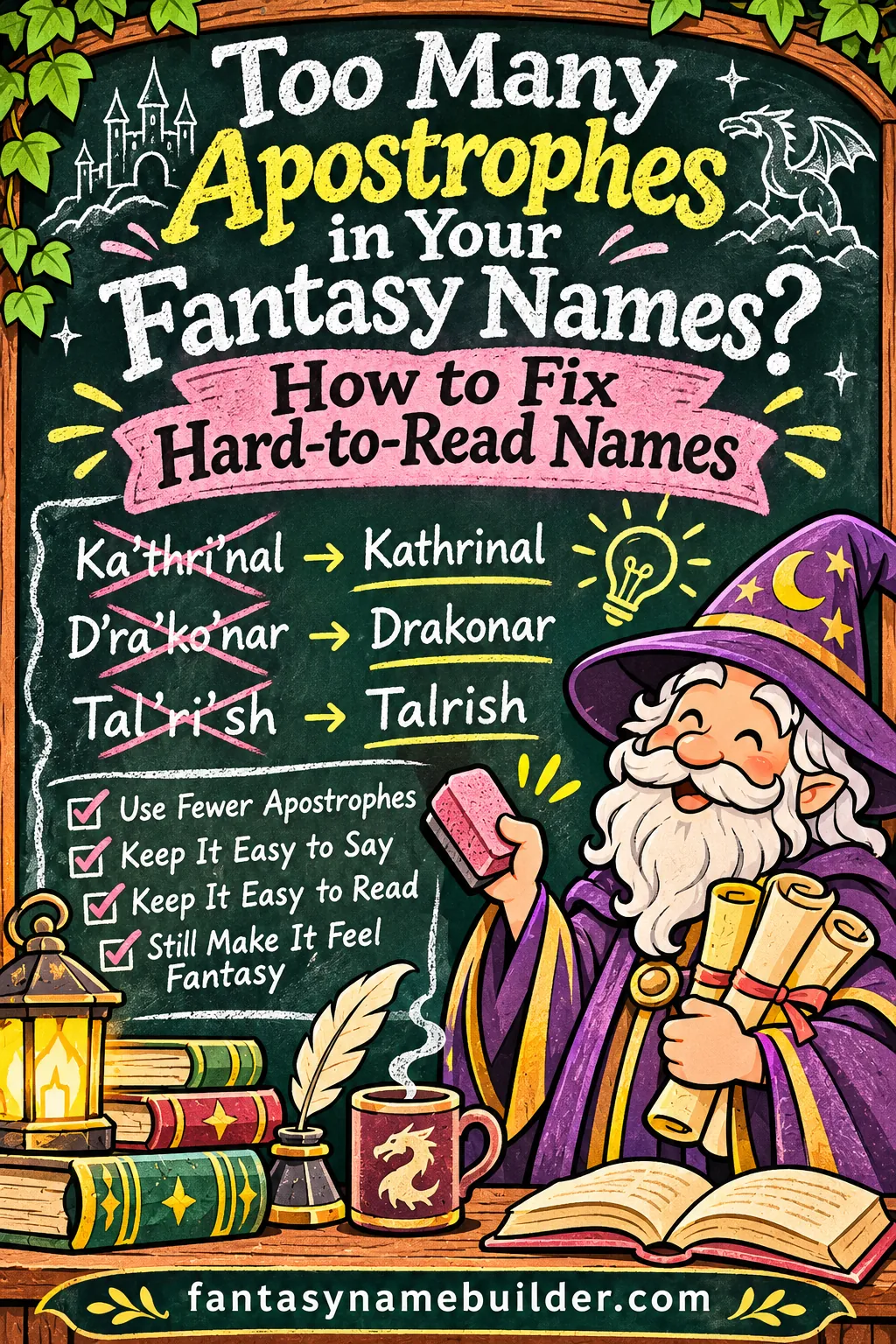
If your fantasy names have too many apostrophes, keep at most one per culture, give it a clear job (like a glottal stop or a clan prefix), and rebuild every other name from simple, sayable syllables. Read each name out loud once. If you hesitate, your reader will too, so cut the punctuation or swap in a cleaner name from the free Fantasy Name Generator, which gives you pages of readable names by race and gender in a few clicks.
That's the short fix. The rest of this guide shows you exactly why apostrophe-heavy names cause trouble, when an apostrophe actually helps, six repair methods with before-and-after examples, and more than 50 ready-to-use readable names sorted by race and role.
⚔️ Pick a name from this list
Tap Next for a name from this page, and save the ones you love.
Why Apostrophes Make Fantasy Names Hard to Read
Most readers don't sound out every word. They glance at a name, store a rough shape of it, and move on. Every time that name appears again, they match it to the shape they stored. A name like Varenna is easy to store: three clear beats, familiar letters, no surprises. A name like Q'zar'thul'ax breaks that habit. The reader has to stop, decide what each apostrophe means, guess at a pronunciation, and then do it all again on the next page because nothing about the shape stuck.
Here's what goes wrong when names pile up apostrophes:
- The reader stalls. An apostrophe is a pause sign. Put three of them in one word and you've put three speed bumps in a sentence that was supposed to move.
- Nobody agrees on the sound. Is the apostrophe a pause? A silent letter? A click? A stress mark? When you don't say, every reader picks a different answer, and some of them pick "skip it."
- Names blur together. When half your cast looks like T'kal, K'tar and R'kal, the punctuation becomes the most noticeable part of each name, so the names stop being distinct.
- It signals "random letters." Readers have seen a lot of fantasy. A name that looks like keyboard spillage tells them the author didn't think about how the language works, even if you did.
- It hurts at the table, too. In a tabletop game, people have to say names out loud dozens of times a session. If your players keep calling the villain "that apostrophe guy," the name isn't working.
None of this means apostrophes are banned. It means each one costs the reader a little attention, so it should buy something in return.
Signs your names have crossed the line
You probably have an apostrophe problem if any of these sound familiar:
- More than one apostrophe appears in a single name.
- Characters from different cultures all use apostrophes in the same way.
- You added the apostrophe because the name "looked too plain" without it.
- Beta readers, editors or players mispronounce the name in different ways.
- You can't explain, in one sentence, what the apostrophe changes about the sound.
- Removing the apostrophe doesn't change how you'd say the name.
That last one is the quickest test. If Dar'ven and Darven sound the same in your head, the apostrophe is decoration, not language.
What an Apostrophe Is Supposed to Do in a Name
In real languages, an apostrophe (or a similar mark) does a specific job. Borrowing one of those jobs gives your invented name a reason to have the mark. Here are the jobs that make sense in fantasy names.
1. Mark a glottal stop
A glottal stop is the little catch in your throat in the middle of "uh-oh." Some languages write that catch with an apostrophe or a similar symbol. If a culture in your world uses that sound often, an apostrophe can show it: Ka'ul is said "Ka-[catch]-ul," two separate vowel sounds with a stop between them, not one smooth "kaul."
This is the most defensible use, and it works best when the apostrophe sits between two vowels. Between two consonants it's much harder to hear.
2. Show a dropped letter or a shortened word
English uses apostrophes for contractions, like "o'clock" from "of the clock." A fantasy culture can do the same: a long formal name shortened in everyday speech. Tamberlin of the Hollow might become Tam'Hollow among friends. The reader can see the shortening happen, and that's a tiny piece of worldbuilding.
3. Separate a prefix or clan marker
Many real naming traditions attach a family or clan element to the front of a name. An apostrophe can mark the seam: Ka'veth means "of the Veth clan," Ka'domir means "of the Domir clan." Once readers learn that Ka' means "of the clan," every name with that prefix tells them something. Now the apostrophe is useful information, not noise.
4. Separate two sounds that would otherwise merge
Sometimes two letters next to each other would be read as one sound. Nathul might be read as "Na-thul" with a "th" sound, but you want "Nat-hul." An apostrophe, Nat'hul, forces the split. This is a narrow use, and often a hyphen or simply choosing different letters works better.
5. Mark a title, honorific or rank
Some cultures could use an apostrophe to attach a title: Ser'Aldwin for a knight, Vey'Lirien for a priestess. It's similar to the clan prefix, but it changes with the character's status, which can be a nice story beat when a character earns or loses the title.
When an apostrophe has no job
If the mark doesn't do one of the jobs above, it's decoration. Decorative apostrophes are the ones that make readers roll their eyes, because they look exotic without meaning anything. The good news is that decorative apostrophes are also the easiest to remove: you just delete them, and usually the name still sounds the same.
| Apostrophe job | What it tells the reader | Example | Works best when |
|---|---|---|---|
| Glottal stop | Pause with a throat catch here | Ka'ul | It sits between two vowels |
| Contraction | A longer name was shortened | Tam'Hollow | The full form appears at least once |
| Clan or family prefix | This person belongs to a group | Ka'veth | Several characters share the prefix |
| Sound separator | Don't merge these letters | Nat'hul | No simpler spelling fixes it |
| Title or rank | This person holds a position | Ser'Aldwin | The title can change in the story |
| Decoration | Nothing at all | Dar'ven | Never; delete it |
The One-Apostrophe Rule (and a Five-Second Test)
Here's the guideline that fixes most apostrophe problems: one apostrophe per name at most, and one apostrophe pattern per culture. That doesn't mean every culture gets an apostrophe. It means if a culture uses them, it uses them the same way every time, so readers learn the rule once and stop worrying about it.
Think of it like a dialect. If your desert clans always attach Ka' to a given name, readers learn that pattern by the third character and read Ka'domir as smoothly as Domir. If your desert clans use Ka', 'ul, Tz' and X'a at random, readers have to decode every name from scratch.
The five-second test for any name
Run every name in your cast through these five quick checks:
- Say it out loud, once, at normal speed. Did you hesitate or stumble? Fix it.
- Spell it from memory after a minute. If you can't, a reader can't either.
- Ask what the apostrophe does. If you can't name the job from the table above, delete it.
- Picture it in dialogue. "Watch out, Q'zar'thul'ax!" doesn't work in a fight scene. "Watch out, Zarthul!" does.
- Check it against the rest of the cast. Does it start with the same letter or share the same punctuation as another major character? Change one of them.
A name that passes all five checks is ready. A name that fails two or more needs one of the repair methods below.
Six Ways to Fix a Name With Too Many Apostrophes
You don't have to throw out a name you love. Most apostrophe-heavy names have a good name hiding inside them. These six methods pull it out. Try them in order; usually the first or second one is enough.
Method 1: Delete the apostrophes and read what's left
Take out every apostrophe and say the result. Mal'ra'zeth becomes Malrazeth. It sounds almost the same, it's one smooth word, and readers can store it in one glance. A surprising number of names need nothing more than this.
If the result runs together awkwardly, move on to Method 2.
Method 2: Keep one apostrophe where it does a job
If the name genuinely has a stop or a clan marker in it, keep the single apostrophe that marks it and delete the rest. K'el'ath'ra becomes Kel'athra: the one apostrophe now marks a clear break between "Kel" and "athra," and it's obvious how to say it.
Ask yourself which pause you'd actually make if you were speaking. Keep that one.
Method 3: Swap the apostrophe for a hyphen or a space
Sometimes what you really have is two names jammed together. Dor'Vashti might read better as Dor Vashti (given name and family name) or Dor-Vashti (a compound name). Readers already know how hyphens and spaces work, so there's nothing to decode.
This is especially useful for titles and clan names. Lady Vashti of House Dor tells the reader more than Dor'Vashti ever could.
Method 4: Respell the sound with ordinary letters
If the apostrophe is standing in for a sound, try writing that sound with letters instead. A glottal stop between vowels can often become a doubled vowel, an "h" or a soft consonant. Ka'ul could become Kahul or Kaul. The exact sound shifts a little, but most readers would never have heard the stop anyway; they'd have just paused awkwardly.
Method 5: Shorten the name
Long names collect apostrophes because the author is trying to break them into chunks. Shorter names don't need breaking. Vel'ithra'mosk'an could become Velith or Ithra or Mosk. Pick the chunk that sounds most like the character, and keep the full version as a formal name if you want one.
A good rule: main characters usually work best at two or three syllables. Save the long, ceremonial names for gods, ancient kings and formal introductions.
Method 6: Give the long version a nickname
If you love the elaborate name, keep it for formal moments and let the other characters shorten it. Your dragon can be introduced once as Zhal'koravex the Unburned and called Korav for the rest of the book. Readers get the flavor of the full name and the comfort of a short one. It's also realistic: people in every culture shorten long names.
Before-and-after examples
Here's what these methods look like on typical problem names. None of these are from published works; they're the kinds of names that show up in early drafts.
| Before | Problem | Method | After |
|---|---|---|---|
| Q'zar'thul'ax | Three marks, no clear sound | Delete and shorten | Zarthul |
| Mal'ra'zeth | Decorative marks | Delete | Malrazeth |
| K'el'ath'ra | Pauses everywhere | Keep one | Kel'athra |
| Dor'Vashti | Two names jammed together | Space | Dor Vashti |
| Ka'ul | Glottal stop most readers skip | Respell | Kahul |
| Vel'ithra'mosk'an | Too long and too chopped | Shorten | Velith |
| Zhal'koravex | Great name, hard in dialogue | Nickname | Korav |
| T'kal and K'tar | Two cast members look alike | Delete and vary | Takal and Kestar |
| Xy'lyth'ra | Odd letters plus marks | Respell and delete | Silithra |
| Gr'unth'ok | Orc name with no reason for marks | Delete | Grunthok |
| S'ss'iriss | Hissing sound overdone | Shorten | Sirriss |
| Ae'lin'dria | Elf name cut into pieces | Delete one, keep flow | Aelindria |
Notice that most "after" names still feel exotic. You don't need punctuation to make a name feel like it belongs to another world. Unusual letter pairs, a strong rhythm and a clear meaning do that job better.
Make Names Feel Foreign Without Punctuation
A lot of writers reach for apostrophes because their names feel too plain without them. That's a real worry, and there are better tools for it.
Use consistent sounds for each culture
Readers recognize a culture by its sounds, not its punctuation. If your mountain folk use hard sounds (k, g, d, r) and short vowels, and your river folk use soft sounds (l, m, n, s) and long vowels, readers will tell them apart instantly, with no apostrophes at all.
| Culture style | Sounds to lean on | Sample names |
|---|---|---|
| Mountain or forge folk | k, g, d, r, short a and o | Bardok, Grenda, Torvik, Kaldra |
| River or sea folk | l, m, n, s, long vowels | Maleen, Sorimae, Ulmora, Nessaly |
| Forest or elf folk | th, l, v, soft endings like -iel, -wen | Ithelle, Vaelith, Sorwen, Thalaris |
| Desert or sun folk | z, sh, h, open a sounds | Zhavira, Hesharo, Azura, Shalor |
| Northern or frost folk | sk, rn, hard endings | Skarn, Hildrun, Torsk, Brenna |
| Shadow or villain courts | v, x, sharp -ex, -ax, -is endings | Corvane, Vexis, Morthax, Silvex |
Pick a signature ending or beginning
A shared ending works like a family resemblance. If many of your elves end in -ith or -ael, readers learn the pattern and recognize elf names on sight. A shared beginning, like Ka- for one clan, can do the same job as a clan apostrophe without the punctuation.
Use unusual but readable letter pairs
Letter pairs like th, ae, zh, kh and rr look distinctly "other" while staying easy to read. Khalden, Aeris and Zhora all feel foreign without asking the reader to decode anything.
Avoid stacking hard letters
Apostrophes often hide a deeper problem: too many hard consonants in a row. Krth'gzk is hard to read with or without the apostrophe. Make sure every syllable has a vowel and you'll avoid most of these problems before they start.
Let meaning do the work
Names with a meaning feel more real than names with punctuation. A surname like Tanwood, Ashmere or Stonebrook tells the reader something about the family's home or history, and it's still clearly a fantasy name. For more patterns like this, the guide on how to create fantasy names goes through syllable building step by step.
Readable Fantasy Names by Race (No Apostrophe Overload)
Here are ready-to-use names you can drop straight into a draft or a campaign. All are original, easy to say on the first try, and sorted by race and role. A few include a single apostrophe with a clear job so you can see what a "good" apostrophe looks like.
Elves
Elves are where apostrophes pile up most often. These names keep the graceful feel without the clutter.
- Ithelle – soft and bright, a healer or singer
- Vaelith – quiet strength, a scout or archer
- Sorwen – gentle and old, a keeper of records
- Thalaris – formal and noble, a court elf
- Aelindria – long and flowing, a queen or high priestess
- Mirethil – musical, good for a bard
- Caelon – short and clean, a young warrior
- Lirien – airy, a wanderer or mage
- Ethavel – calm and wise, an elder
- Nimara – light and quick, a trickster
- Saelthis – sharp edge, a duelist or spy
- Varenna – warm, a guardian of a forest village
Looking for more? The elf names page has hundreds of male, female and surname options.
Dwarves
Dwarf names rarely need apostrophes; they get their character from hard consonants.
- Bardok – stubborn and loyal
- Grenda – a forge-master with a sharp tongue
- Torvik – a miner with a long memory
- Kaldra – a shieldmaiden
- Dorrum Ashmantle – a clan elder
- Hildrun – a brewer and storyteller
- Brannoc Stonebrook – a traveling smith
- Ragna Coalhand – a tunnel engineer
Orcs and half-orcs
Orc names get a lot of apostrophes because writers want them to sound harsh. Short, blunt syllables do that better.
- Grummok – a war leader
- Ushga – a clever scout
- Thrak – a young, eager fighter
- Morza Bonejaw – a shaman
- Durgash – a camp cook who fights with a cleaver
- Kragga – a chieftain's sister
- Orrum – a quiet, steady guard
- Zhurka – a raider turned mercenary
Humans
Human names in fantasy can lean familiar. The trick is a slightly unusual spelling or a meaningful surname.
- Dorvan Hale – a soldier who wants a quiet life
- Thessane Morne – a noble with secrets
- Kaedric Ashmere – a knight errant
- Elowen Barrow – a village herbalist
- Orrin Vale – a ranger
- Maelis Corran – a sailor's widow
- Bram Tollen – an innkeeper
- Ysolde Wren – a court scribe
Halflings and gnomes
These names are short and friendly by nature. They almost never need punctuation.
- Brisk Tanwood – a halfling cook
- Pip Hollowell – a nosy neighbor
- Marigold Fenn – a halfling archer
- Tibble Quickfuse – a gnome tinkerer
- Nessa Burrowby – a halfling courier
- Fizwin Coggle – a gnome alchemist
Dragons and ancient beings
Long names suit dragons, but even here, one strong name beats a chopped-up one.
- Seraveth – a wise old dragon
- Vorthagax – a greedy red-scaled tyrant
- Ulmora – a sea serpent
- Korthyss – a shadow wyrm
- Zhal'koravex – formal name with one stop; called Korav day to day
- Aurelthane – a gold dragon who guards a library
Desert clans with one consistent apostrophe
This is what a well-built apostrophe pattern looks like. In this sample culture, Ka' means "of the clan," and it's the only apostrophe the culture ever uses.
- Ka'veth – of the Veth clan, a caravan leader
- Ka'domir – of the Domir clan, a water-finder
- Ka'suri – of the Suri clan, a storyteller
- Ka'alen – of the Alen clan, a young guard (the apostrophe also marks a stop between the two a's)
Every name follows the same rule, so readers decode it once and never again.
Villains
Villain names are the biggest apostrophe trap of all, because writers want them to sound menacing. Menace comes from hard endings and dark sounds, not punctuation.
- Corvane – a cold, careful schemer
- Vexis – a cult leader
- Morthax – a warlord
- Silvex – a poisoner at court
- Draemor – a fallen paladin
- Nethra – a witch-queen
For more dark options, browse villain names or dark fantasy names.
How to Make Readable Names in the Free Tool
The free Fantasy Name Generator is a fast way to replace a cluttered name with one readers can say on the first try. Here's exactly how to use it for this job.
- Pick the race. Choose the race of the character you're renaming, like Elf, Dwarf, Orc or Human. If you're not sure, leave it on All Races or use Browse All Races to see every option.
- Pick the gender. Choose Any, Male, Female or Neutral to fit your character.
- Pick the length. Choose Short for main characters and anyone who gets named in dialogue a lot. Short names are easier to read and almost never need punctuation. Choose Long for gods, ancient beings and formal titles.
- Pick the format. Use First only while you're replacing a given name, so you can judge it on its own. Switch to Full name or Surname only once you've found a first name you like.
- Click Generate ✦. You'll get a fresh list of names.
- Page through with ‹ ›. Read each name out loud. Skip anything you stumble on.
- Save the keepers with ♡. Every name that passes the five-second test goes to your Saved list.
- Export your list with ⬇ Export .txt. Keep the file next to your draft or campaign notes so you can pull names later without starting over.
Settings cheat sheet
| What you're fixing | Race | Length | Format |
|---|---|---|---|
| Main character's first name | Character's race | Short | First only |
| A whole cast from one culture | One race, kept the same | Short | Full name |
| A god or ancient dragon | Dragon or any race | Long | First only |
| Family names for a noble house | Character's race | Short | Surname only |
| Minor NPCs in a tavern scene | All Races | Short | Full name |
Use the tool to build a culture's pattern
If one culture in your world does use a single apostrophe pattern, the tool can still help. Generate a list of names for that race, save ten that share a similar sound, then add your one consistent prefix or marker to each. You get names that feel related, and only one rule for readers to learn.
Apostrophe Problems and Quick Fixes
Use this table when a name feels wrong but you're not sure why.
| Problem | Why it happens | Quick fix |
|---|---|---|
| Readers mispronounce the name | Apostrophe meaning isn't clear | Remove it or explain the sound once in the text |
| Names in the cast look alike | Same punctuation and first letter | Change first letters and drop shared marks |
| The name looks like a typo | Marks between consonants | Add vowels and delete the marks |
| The name is too long to use in dialogue | Long name chopped into chunks | Shorten it or give a nickname |
| Every culture uses apostrophes | Used for flavor, not meaning | Give apostrophes to one culture only |
| Name feels plain without apostrophes | Sounds aren't distinctive | Use culture sounds and signature endings |
| Players keep forgetting the name | Hard to say means hard to remember | Pick a Short name from the generator |
| Name has two apostrophes you like | Both feel like real pauses | Keep one, replace the other with a hyphen |
| Audiobook or read-aloud sounds awkward | Glottal stops between consonants | Respell with ordinary letters |
| Editor flags the name | Clutter on every page it appears | Run the six fix methods in order |
Help readers with the names you keep
If you decide to keep an apostrophe, give readers a little help:
- Show the sound early. The first time the name appears, a character can say it slowly or correct someone else's pronunciation.
- Use it consistently. Same spelling, same mark, every single time.
- Introduce it in a calm scene. A new hard name in the middle of a battle is twice as confusing.
- Add a pronunciation guide at the back of a novel or in your campaign notes for players. It's optional, but readers who care will use it.
- Keep the rest of the scene simple. Don't introduce three apostrophe names on the same page.
For Game Masters: Names Players Can Actually Say
Tabletop games put extra pressure on names, because everyone at the table has to say them out loud, often while excited or in a hurry. A name that looks fine on paper can fall apart when four people try to say it in four different ways.
A few habits help:
- Say the name before writing it. If you introduce an NPC by voice, players learn the sound first and won't get stuck on the spelling.
- Keep major NPC names short. Anyone your players will talk about every session should have a one- or two-syllable handle.
- Write names on a shared list. Players can check spelling without asking every time.
- Let the table nickname long names. If your players start calling Zhal'koravex "Korav," lean into it. It's a sign they care about the character.
For quick character names that are easy to say at the table, browse D&D character names, or generate a fresh batch in the free name generator and pick the ones that roll off your tongue.
Frequently Asked Questions
Why do fantasy names have so many apostrophes?
Writers often add apostrophes to make names look foreign or ancient. Sometimes the mark stands for a real sound, like a glottal stop, but often it's just decoration. Decorative apostrophes are the ones that make names harder to read without adding anything.
Is it wrong to use apostrophes in fantasy names?
No. An apostrophe is fine when it does a clear job, such as marking a pause, a shortened word or a clan prefix. The trouble starts when a name has several of them or when every culture in the world uses them for no reason.
How many apostrophes should a fantasy name have?
At most one per name, and ideally only one consistent apostrophe pattern per culture. Many great fantasy names have none at all. If you can delete the apostrophe without changing how you'd say the name, delete it.
What does an apostrophe mean in a fantasy name?
It means whatever you decide, as long as you're consistent. The most common meanings are a glottal stop (a short catch in the throat), a dropped letter, or a marker joining a prefix like a clan or title to the name. Show readers the meaning early so they can read the name with confidence.
What is a glottal stop?
A glottal stop is the brief catch in your throat you make in the middle of "uh-oh." Some languages write it with an apostrophe. In a fantasy name, it works best between two vowels, as in Ka'ul, where readers can actually hear the break.
How do I make a fantasy name sound exotic without apostrophes?
Use consistent sounds for each culture, a signature ending like -ith or -ax, and distinctive letter pairs like th, zh or ae. A meaningful surname such as Ashmere or Stonebrook also adds depth. Readers notice patterns far more than punctuation.
How can I tell if my fantasy name is too hard to read?
Say it aloud once at normal speed, then try to spell it from memory a minute later. If you stumble or can't spell it, readers will have the same trouble. Asking a friend to read it cold is the fastest real-world test.
Can a name generator help fix hard-to-read names?
Yes. The free generator lets you pick a race, gender, Short or Long length, and First only, Surname only or Full name format, then page through results. Read each one out loud, save the easy ones with ♡, and export your list when you're done.