My Character's Name Sounds Like Gandalf: How to Avoid Copying a Famous Name
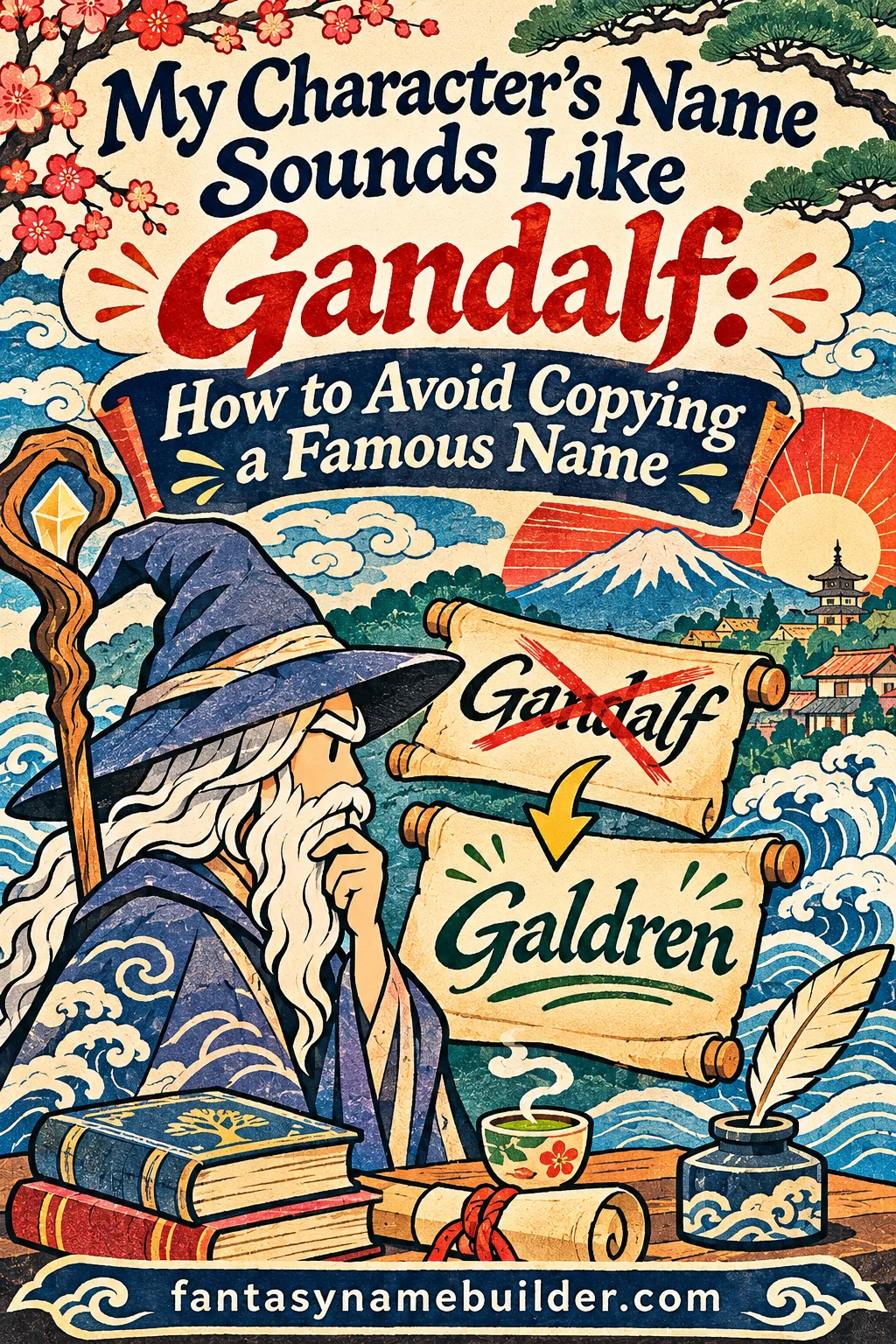
If your fantasy name is too similar to a famous character, change the parts people actually hear, which are the first syllable, the stressed beat and the ending, then search the new name before you commit to it. Swapping one letter almost never fixes the problem, because readers recognize a name by its sound and rhythm, not its spelling. The fastest fix is to generate a batch of fresh options in the free Fantasy Name Generator, keep the two or three you like, and run each one through the quick checks below.
That uneasy feeling usually shows up at a bad moment. You've written forty pages, or your character has survived six game sessions, and someone at the table says, "Wait, isn't that basically Gandalf?" Suddenly the name you loved feels borrowed.
The good news is that this is one of the easiest problems in fantasy writing to solve. Names that echo famous characters happen because the most popular fantasy books and games shaped what "sounds magical" to all of us. You absorbed those patterns without trying. This guide shows you how to spot the echo, how to measure how close it really is, and how to replace it with something that feels like it belongs only to your character.
⚔️ Pick a name from this list
Tap Next for a name from this page, and save the ones you love.
Why Some Names Feel "Too Close" to a Famous Character
Your brain doesn't compare names letter by letter. It compares them by shape. When a new name shares enough of a famous name's shape, readers hear the famous one first, even if half the letters are different.
Here are the five features that make up a name's shape, roughly in order of how much they matter.
1. The opening sound. The first consonant and vowel carry the most weight. A name that starts with "Gan" or "Gal" and belongs to an old wizard is already halfway to a famous echo, no matter how it ends.
2. The stress pattern. Say the name out loud and clap on the strong beat. A two-syllable name stressed on the first beat (DUM-da) feels different from one stressed on the second (da-DUM). If your name has the same number of syllables and the same stressed beat as a famous name, it'll sound related.
3. The ending. Endings like -alf, -orn, -olas, -dor and -iel are strongly tied to specific well-known characters and places. A distinctive ending can trigger recognition all by itself.
4. The letter signature. Some famous names have an unusual feature, like a rare letter (z, x, q), a doubled letter, or an apostrophe. If your name shares that oddity, it borrows some of the famous name's identity.
5. The context. This is the one people forget. A name that sounds a little like a famous wizard isn't a problem for a blacksmith. Put that same name on a gray-bearded wizard with a tall hat and a fondness for fireworks, and the resemblance gets louder. Role, look and personality all amplify sound.
That last point matters a lot. Sometimes the name isn't really the problem. The whole character is built from the same blueprint, and the name just happens to be the part people notice first.
A quick way to rate the overlap
Take your name and the famous name it reminds you of, then score one point for each feature they share.
| Feature | Shared? | Score |
|---|---|---|
| Same first sound (first consonant plus vowel) | Yes or no | 1 point |
| Same number of syllables and same stressed beat | Yes or no | 1 point |
| Same ending sound | Yes or no | 1 point |
| Same unusual letter or punctuation | Yes or no | 1 point |
| Same role, race or look | Yes or no | 1 point |
0 to 1 points: You're fine. Lots of names share a sound or two. That's how language works.
2 points: Borderline. Usually fine for a minor character, worth a tweak for a main one.
3 or more points: Readers will probably notice. Change at least two of the shared features, or pick a new name.
This isn't a scientific scale, just a practical gut check. It helps you see why a name feels off, which tells you exactly what to change.
The 5-Minute Originality Check
Before you fall in love with a new name, run it through this short routine. It catches most problems early, when changing the name costs nothing.
Step 1: Say it out loud three times. Then say it in a sentence your character would hear, like "Get down, [name]!" or "The council summons [name]." Names that look fine on the page sometimes sound like something else entirely when spoken.
Step 2: Ask someone cold. Text a friend or your gaming group just the name, with no context, and ask, "What does this remind you of?" If more than one person names the same famous character, take that seriously. You're too close to your own name to judge it fairly.
Step 3: Search the exact name. Type the name into a search engine in quotation marks, then search it again with words like "fantasy," "character," "book," and "game" added. Look at the first page or two of results.
Step 4: Search the near misses. Try the name with one letter changed in a few spots, and with common spelling swaps (c and k, i and y, ph and f). If a near miss is a famous character, readers may land there too.
Step 5: Check the fan wikis. Big book series and game franchises have fan wikis that list every minor character. A name can be obscure to you and well known to fans of a series you've never read. A quick search on a wiki for the series in your genre is worth the minute it takes.
What your search results mean
| What you find | What it means | What to do |
|---|---|---|
| Nothing, or only random usernames | The name is effectively fresh | Keep it |
| A real person's first or last name | Very common and usually harmless | Keep it unless it's a famous public figure |
| A minor character in a small indie work | Low risk of confusion for most readers | Keep it for games, consider a tweak for publishing |
| A minor character in a huge franchise | Fans of that series will notice | Tweak the ending or first sound |
| A major character, place or creature in a famous work | Readers will notice right away | Change the name |
| A trademarked product or company name | Could cause trouble beyond reader confusion | Change the name |
Remember that a total absence of results is rare for short names. Short names like "Kael" or "Bren" show up everywhere because they're simple sound combinations. That's not copying. The problem is only when a name points clearly to one specific famous character.
Why "Just Change One Letter" Usually Fails
The most common fix people try is swapping a single letter. It feels like enough, because the spelling now looks different. But readers don't read fantasy names carefully. They skim, then sound them out in their heads once, and after that they recognize the name by its outline.
A one-letter change keeps the outline almost untouched. If you change a middle vowel or a middle consonant, the first sound, the stress and the ending all stay the same. In the scoring table above, you still have three or four points.
Here's how different kinds of edits affect how a name sounds, using invented names so you can see the pattern.
| Type of change | Example | Does it fix the echo? |
|---|---|---|
| Swap a middle letter | Taravel to Tarevel | No. Same start, beat and ending |
| Swap a silent or doubled letter | Morrin to Moryn | No. Sounds identical when spoken |
| Change only the spelling of the same sound | Kaelith to Caelith | No. Readers hear the same name |
| Change the ending family | Taravel to Taravorn | Partly. The start still echoes |
| Change the first syllable | Taravel to Oshravel | Mostly. Shape shifts a lot |
| Change first syllable and ending | Taravel to Oshravin | Yes. It reads as a new name |
| Change the syllable count | Taravel to Tarn | Yes. Rhythm is totally different |
The rule of thumb is simple: change at least two of the three big sound zones (beginning, stressed beat, ending), or change the length. Spelling tricks alone never count.
One more trap: adding an apostrophe or an extra "h" doesn't make a name new. Readers just skip over decorations. If anything, unusual decoration on a familiar name can make it look like you were trying to hide the borrowing.
Seven Fixes for a Name That Sounds Borrowed
Once you know which features overlap, you can fix the name on purpose instead of guessing. Pick one or two of these, depending on your score.
1. Replace the opening sound
This is the strongest single fix, because the first sound is what readers latch onto. Change both the first consonant and the first vowel. If your name starts with a hard "G" or "K," try a softer opener like "Th," "S," "Hal" or "El." If it starts soft, try something with more grit, like "Br," "Dr," "Gr" or "Kor."
Example: Galvaren becomes Thelvaren. The ending stays, but the name now opens with a breathy, quieter sound and stops pointing toward any famous gray wizard.
2. Move the stressed beat
Add a syllable at the front or drop one, so the strong beat lands somewhere new. A two-syllable name stressed on the first beat can become a three-syllable name stressed on the second.
Example: MOR-dun (strong first beat) becomes e-MOR-dun or mor-DUH-nel. The listener's ear has to work differently, so the echo fades.
3. Switch to a different ending family
Endings carry a lot of flavor. Swap a famous-sounding ending for one from a different "family" of sounds.
| If your ending is like... | Try an ending like... |
|---|---|
| -alf, -olf | -ammer, -oth, -ick, -wen |
| -orn, -dor | -ast, -ell, -imar, -ew |
| -olas, -elas | -enne, -isk, -arro, -ute |
| -iel, -wen | -ara, -ith, -ove, -ess |
| -ond, -and | -ira, -umb, -ock, -elt |
| -ath, -oth | -inn, -ary, -ue, -ombe |
You don't have to match these exactly. The point is to step out of the ending that triggers the famous name.
4. Change the length
Turning a long name into a short one, or a short one into a long one, changes the rhythm completely. A wizard named Bremm feels very different from a wizard named Bremmeryth. Short names feel blunt, practical and modern. Long names feel formal, old and ceremonial.
5. Drop the unusual letter or punctuation
If the famous name has a z, x, q, apostrophe or doubled vowel that you also used, remove yours. That unusual letter is often the "signature" readers remember. Taking it out makes your name stand on its own.
6. Add a surname or title that pulls attention
Sometimes a first name is fine but feels too bare. Pairing it with a strong surname or title changes how people say it and remember it. "Ethrimund" alone might remind someone of something. "Ethrimund Ashcombe of the Lantern Road" sounds like its own person. The surname becomes the part people use.
This works best for borderline names with a score of 2. It won't save a name that's clearly copying.
7. Rebuild from meaning instead of sound
If you keep landing near famous names, you may be building from sound alone, which pulls you toward the sounds you've heard most. Try starting from meaning instead. Decide what the name means in your world (gray traveler, river-born, ash-keeper), then build syllables for those ideas in your own invented language or from plain word roots. The guide to how to create fantasy names walks through building names from roots and syllable sets, step by step.
How to Make a Fresh Name in the Free Tool
When fixing a name by hand starts feeling like a puzzle with no answer, the easiest move is to generate a batch of fresh names and pick from them. The Fantasy Name Generator builds names from race-based sound sets, so the results don't lean on the handful of famous names stuck in your head.
Here's the exact process.
1. Pick the right race. At the top of the tool, choose a race. If your character is an elf, choose the elf option. If you aren't sure, or you want a wider range of sounds, leave it on All Races. You can also click Browse All Races to see every option at once.
2. Set the gender. Choose Any, Male, Female or Neutral. If your old name had a strong gendered ending you liked, match that setting so the new options feel similar in tone.
3. Choose a length. Pick Short for blunt, punchy names, or Long for formal, old-sounding ones. Here's a handy trick: if your current name is long and feels too close to a famous one, switch to Short. Changing the length is one of the fastest ways to break the echo.
4. Pick a format. Choose Full name if you want a first name and surname together, First only if you just need a new given name, or Surname only if you're keeping your first name and want a stronger family name (fix number 6 above).
5. Generate and page through. Click Generate ✦. Use the ‹ and › arrows to page through more results. Don't stop at the first screen. Read at least three or four pages so you have plenty to compare.
6. Save the contenders. Tap the ♡ on any name you like. Your picks collect in the Saved list, so you can compare them side by side later.
7. Export your shortlist. When you have five to ten saved names, click ⬇ Export .txt to download them as a plain text file. Keep that file with your notes or campaign folder.
8. Run the checks. Take your top three names through the 5-Minute Originality Check above. Score each one. Keep the name with the lowest score that still feels right for the character.
Settings that help with specific problems
| Your problem | Try these settings |
|---|---|
| Wizard name sounds like a famous wizard | Race: Human or All Races; Length: Short; Format: Full name |
| Elf name sounds like a famous elf archer | Race: Elf; Length: Long; Gender: Neutral for unexpected sounds |
| Dwarf name sounds like a famous dwarf king | Race: Dwarf; Format: Surname only, then pair with a new first name |
| Dark lord name sounds like a famous villain | Race: All Races; Length: Short; skip anything starting with S or M if that's your echo |
| Halfling name sounds like a famous hobbit-style hero | Race: Halfling; Format: Full name; Length: Long |
| You keep picking the same sounds | Race: All Races; Gender: Any; page through at least five pages |
If you're stuck on one specific type of character, the race and class pages give you focused lists. The wizard names page is a good starting point for anyone whose spellcaster keeps drifting toward a famous gray beard.
A sample session
Say your old wizard's name is "Galdren," and three friends said it sounds like Gandalf. Score it: same first sound (Ga), same two-syllable shape with the beat up front, similar ending feel, same role. That's four points.
You set the tool to All Races, Male, Short, Full name, and generate. Over four pages you save names like Orveth Callowmere, Ethrimund Vale, and Tobren Hask. You export them. Then you score each one against the famous name. Orveth starts with a soft vowel, ends in a breathy -eth, and shares nothing but the role. Score: one point. You keep Orveth, and nobody at the table blinks.
Original Names for the Roles That Echo Famous Characters Most
Some character types are so tied to a few famous examples that almost any name you pick will drift toward them. Wise old wizards, elf archers, dwarf kings and dark lords are the big ones. The lists below give you original names built to sound right for each role while steering clear of the most famous sound patterns. Each name was made up for this page. Still, run your favorite through the search check before you commit, since new books and games come out all the time.
Wise old wizards and mentors
These avoid the hard "G" opener and the -alf, -dor and -dore endings.
- Orveth Callowmere
- Ethrimund Vale
- Hesketh Arrowby
- Tobren Hask
- Pellam Oakwright
- Isembard Quell
- Lowan Thrisk
- Corrimer Ashby
- Wendrel Fosse
- Abelorn Tusk
Elf archers and scouts
These skip the -olas, -iel and -wen endings that fill fantasy shelves.
- Saoven Kell
- Thessaly Moor
- Ilvaro Senn
- Ruvenne Ash
- Cailith Darrow
- Ennesk Liral
- Sindrevai
- Maeros Thane
- Veylin Ostra
- Arrisande
Dwarf kings, smiths and clan leaders
These trade the famous "Th" openers and -orin, -ain endings for blunter, rock-heavy sounds.
- Brannoch Tellhold
- Gruma Stonewhistle
- Hordek Blackbellow
- Ottrin Grauss
- Durvala Anvilsong
- Krell Hammerdown
- Bodrik Saltmantle
- Magra Ironwick
- Feyla Coalbright
- Torvund Ashdeep
Dark lords and villains
Villain names often drift toward "S" and "M" openers with hissing or rumbling endings. These go elsewhere.
- Korrath Uml
- Ashkarel
- Vexil Draun
- Ophira the Unwept
- Calderon Vash
- Hulgrave
- Ysmet Corrow
- Thane Ebbrick
- Nalvorra
- Quorrin Black
For more villain options with different sound sets, the villain names page has a full list by style.
Small, brave heroes
Cheerful halfling and gnome heroes often end up with names that sound like famous hobbit-style characters. These lean on plain, earthy English sounds instead.
- Quillan Ostrey
- Tamsel Brightfold
- Hob Fennerly
- Poppy Mardle
- Wick Tallowby
- Nettle Greaves
- Barnaby Coombe
- Linnet Haysworth
- Tuck Ambleside
- Clover Pennick
Warrior queens and battle heroines
- Maelis Varrow
- Ingrith Dawnspear
- Sorcha Vell
- Adaryn Kest
- Haldis Ironbriar
- Rowenna Ashgrave
- Tavia Coldmere
- Brisel Haunt
- Ennith Warrow
- Kestra Valde
If none of these fit, the fantasy character names page groups hundreds more by type, and the generator will keep producing new ones as long as you keep clicking.
Special Cases: Homage, Fan Fiction, Tabletop Games and Publishing
How much a famous echo matters depends a lot on what you're making and who will see it.
Tabletop games with friends
At a home game, a name that sounds like a famous character is rarely a real problem. Your group might laugh about it once, and then the name becomes your character's. If the joke keeps coming up and it bothers you, rename the character in-world. A nickname, a new title earned in battle, or a name taken after a big story moment is a fun way to switch without breaking the game.
Homage on purpose
Sometimes you want readers to catch a reference, like a nod to a story you love. That's a choice, not a mistake. The key is to make it small and clear. A minor innkeeper whose name winks at a famous character reads as a friendly in-joke. A main character with a near-copy name reads as borrowing. If you go for homage, keep it to background characters and make sure the character's personality is clearly their own.
Fan fiction
In fan fiction, you're already using another creator's characters, so original characters you add should have names that feel at home in that world without copying existing ones. Use the same five-feature check, but compare your name against the main cast of the series you're writing in. Fans know every name, including minor ones.
Self-publishing and selling your work
If you plan to publish or sell a book, game or module, take the originality check more seriously. Readers who notice a strong echo may assume the whole book is derivative, and that can show up in reviews. Names of famous characters and franchises can also be connected to trademarks, and that's a legal area this guide can't advise on. If your work is commercial and you have any doubt about a name, talk to a qualified professional before you publish. The simplest path is to choose a name that clearly doesn't point to anyone else.
Real names and historical names
Plain real-world names (Thomas, Margaret, Aldous) can't be "copied" from a fantasy character just because one famous character also used them. Lots of fantasy characters have ordinary names. What matters is whether your full name, role and look together point to one specific famous character.
Troubleshooting: Common "Too Close" Situations
| Situation | Why it happens | Best fix |
|---|---|---|
| Every wizard name you invent starts with G or M | You're pulling from the wizards you've read most | Generate with All Races and pick names with different openers |
| Your elf name ends in -iel or -wen | These endings are everywhere in classic fantasy | Switch the ending family using the table above |
| Your name is fine, but your character's look matches a famous one | The context, not the name, is causing the echo | Change one visual detail, like robe color, weapon or age |
| A friend says it reminds them of a game character you've never heard of | Big games have huge casts that are easy to miss | Search the name on a fan wiki; tweak if it's a major character |
| The name is a real word in another language | Short invented names often collide with real words | Search the name with the word "meaning" and decide if it fits |
| You've already used the name for 50,000 words | Renaming feels huge | Use find-and-replace, then reread key scenes to fix rhythm |
| Your group already loves the name | The table is attached to it | Keep it for home games; change it before publishing anything |
| You can't stop comparing every new name | Too many options feel like too few | Limit yourself to three saved names, score them, and pick one |
Renaming a character mid-project
If you decide to rename, don't panic about the work you've done. Use your writing program's find-and-replace for the full name, then search separately for nicknames, possessive forms and any short version. After that, reread two or three scenes where the name appears in dialogue. A new name with a different rhythm can change how a line sounds, and small tweaks to the surrounding words help it settle in.
At the game table, just announce it at the start of a session and update your character sheet. Most groups adjust within one session.
Make Your Name Truly Your Own
A name feels original when it has its own sound and when the character behind it is clearly a different person. Run the five-feature check, fix two sound zones instead of one letter, and test the name on someone who doesn't know the backstory. Then give the character habits, flaws and a voice that no famous character has. That's what makes readers remember your name for its own sake.
When you're ready for fresh options, open the free Fantasy Name Generator, pick your race, gender, length and format, then generate a few pages, save your favorites with ♡ and export the shortlist.
Frequently Asked Questions
How do I know if my fantasy name is too similar to a famous character?
Compare the opening sound, the stressed beat, the ending, any unusual letter and the character's role. If three or more match a famous character, readers will probably notice. A quick search of the exact name and asking a friend what it reminds them of will confirm it.
Is changing one letter enough to make a name original?
Usually not. One letter rarely changes how the name sounds, so readers still hear the famous name. Change at least two of the three main sound zones (beginning, stressed beat, ending), or change the length of the name.
Can I use a name that already belongs to a minor character somewhere?
For home games and personal projects, it's usually fine, especially if the original is obscure. For published work, check how well known that character is. If it's from a huge franchise with an active fan base, a small tweak is a safe idea.
Is it plagiarism to use a name that sounds like a famous fantasy name?
A similar-sounding name on its own usually isn't what people mean by plagiarism, which is about copying someone else's work. The bigger risk is that readers see your character as derivative. If you're publishing commercially and worried about a specific name, ask a qualified professional, since this guide can't give legal advice.
What's the fastest way to get a name that doesn't sound borrowed?
Use the free generator with a race and length that differ from the name you're replacing, page through several screens, and save a few favorites. Then run your top three through a search check and pick the one with the lowest overlap score.
My gaming group already calls my character by the old name. Should I change it?
If it doesn't bother you, keep it. Home games are about fun, and a name that sounds a bit familiar won't hurt anyone. If it does bother you, rename the character in-world with a new title or chosen name so the switch feels like part of the story.
Do real-world names like Thomas or Elena count as copying?
No. Ordinary real names are shared by millions of people and plenty of fictional characters. They only become a problem when the full name, role and look together clearly point to one famous character.
How do I stop drifting toward famous names when I invent my own?
Start from meaning instead of sound, so you aren't pulling from the names you've heard most. Building from word roots, or using a generator set to a different race than usual, also breaks the habit of reaching for the same familiar syllables.