Naming Rivers, Seas and Regions on Your Fantasy Map
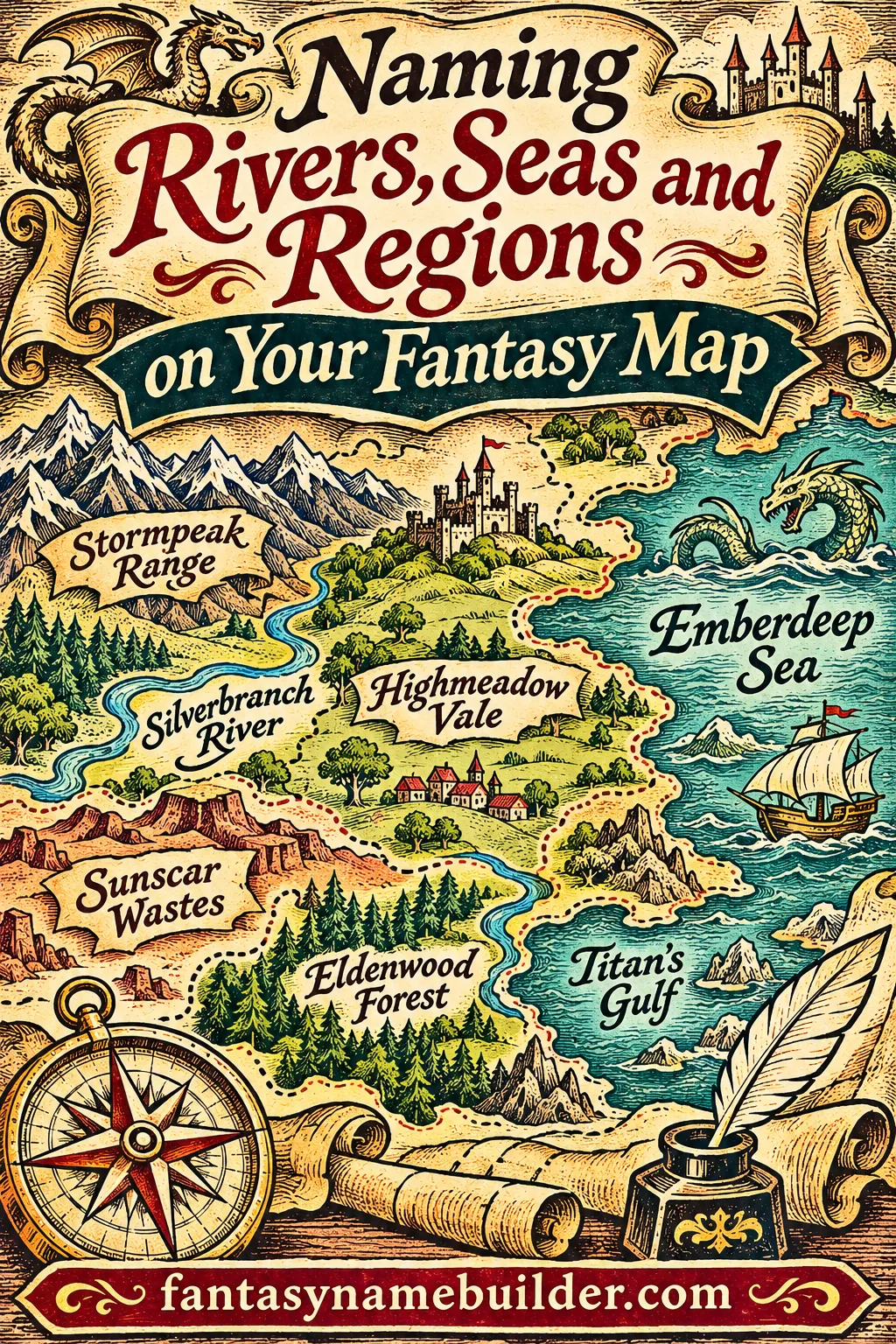
Fantasy map names stop sounding random the moment you decide who named each place and stick to one sound style per culture, then mix in plain descriptive names like the Graywash or the Low Fens that locals would actually use. Real maps work the same way: some names describe the land, some honor a person, and some are old words nobody remembers. The free Fantasy Name Generator helps with the people part, giving you founders, explorers and legendary figures whose names can become rivers, seas and regions.
Below you'll find a simple naming system for your whole map, formulas for each kind of feature, more than 200 ready-to-use river, sea, lake and region names, exact tool settings, and fixes for the most common problems mapmakers run into.
⚔️ Pick a name from this list
Tap Next for a name from this page, and save the ones you love.
Why Your Map Names Feel Random (and the Real Fix)
You've drawn the coastline, carved the rivers down from the mountains and shaded in the forests. Then you start labeling, and something feels off. The names look like they were pulled from different hats, because they were.
Map names feel random for three main reasons:
- No single "voice" per region. One river is called Xyrrhanthos, the next one is the Blue River, and the sea between them is called Merivelle. Each name is fine alone, but together they don't sound like they belong to one world.
- Every name is invented from scratch. Real places are rarely pure inventions. They describe something ("Red River"), honor someone ("Lake Tarrow"), or keep an old word whose meaning has faded. If every name is a made-up string of sounds, the map feels like a word puzzle instead of a place.
- Too many names in one style. A map where everything is "the Something Something" feels flat. A map where everything is an exotic invented word feels exhausting to read.
The fix is to think like a historian, not a word generator. Ask who lived near each river, sea or region, what language they spoke, and what they cared about when they named it. Once you answer that, the names start to choose themselves.
Step One: Decide Who Named Each Place
Before you write a single label, sketch out the main cultures on your map. You don't need full languages. You just need a rough sense of how each group's names sound and what they tend to name things after.
Build a simple culture sound kit
Pick three to five cultures and give each one a small "sound kit." This is a short set of rules that keeps their names consistent.
| Culture | Sound feel | Common pieces | What they name things after | Sample names |
|---|---|---|---|---|
| Lowland humans | Plain, practical, English-like | -ford, -mere, -mark, -wash, Gray, Low, Salt | What the place looks like or does | The Graywash, Saltmere, Brennmark |
| Forest elves | Soft, flowing, many vowels | vael, -wen, -iel, el-, -ora, l, s | Feelings, seasons, songs | Vael Odrin, Ellowen Vale, Sillora |
| Mountain dwarves | Hard, short, heavy consonants | kh-, -un, -dur, -grim, -az, k, r | Stone, depth, clan founders | Kharrun Deep, Dur Azgal, Grimmbek |
| Sea traders | Bright, rolling, sea-flavored | port-, -ara, -isso, -enza, r, n | Ports, trade goods, captains | Portessa, Varenza Sound, Isso Bay |
| Steppe riders | Open, rhythmic, two-part names | -tai, -ush, -an, kh, double vowels | Horses, winds, distances | Khaltai Plains, Ushaan Water |
Notice how each culture has a different reason for naming things. The lowlanders are practical, so their rivers are called the Graywash or the Thousand Fords. The elves are poetic, so a river might be named for a lament. The dwarves name things for depth and their own ancestors. That difference in "why" matters as much as the difference in sound.
Let borders show up in the names
Here's where your map comes alive. When a river runs from elven forest into human farmland, it can have two names. The elves upstream call it Vael Odrin, and the humans downstream just call it the Odrin, or even the Oddering, because they've worn the old word down over time. A sea between two peoples might be the Sea of Lanterns to one side and Lumessa to the other.
Real-world maps are full of this layering, and readers sense it even if they never think about it. It makes your world feel old. You don't need many examples. Two or three dual-named features on a whole continent are enough to give that impression.
How to Name Rivers
Rivers are often the oldest names on a map. People settled along them long before they drew borders, so river names tend to be short, worn down and sometimes hard to translate. That's a useful rule of thumb: the bigger and older the river, the shorter and stranger its name can be.
River naming formulas
| Formula | How it works | Examples |
|---|---|---|
| The + descriptive word | What the water looks or sounds like | The Graywash, The Brightrun, The Murmur |
| Color or quality + River | Plain, easy, very common in real maps | Red River, Cold River, Silver River |
| Old short name | One or two worn syllables, meaning forgotten | The Odrin, The Seld, The Avra |
| River + Person | Named for a hero, ruler or explorer | River Seldra, Tarrow's Run, Aldren Water |
| Feature + water word | Describes a crossing or shape | The Thousand Fords, Twinbend, Longrun |
| Culture word + suffix | Built from a culture's sound kit | Vael Odrin, Kharrun, Ushaan Water |
| Event + water | Named for what happened there | Bloodford, the Drowning, Oathwater |
Water words beyond "river"
Swapping "river" for a more specific word adds instant texture, and each one tells a reader something about the water.
- Run: fast and narrow (Tarrow's Run)
- Wash: wide, shallow, often muddy (the Graywash)
- Water: old and plain (Aldren Water)
- Brook / Beck / Burn: small streams, often in hill country
- Rill: a tiny trickle
- Ford: a shallow crossing point, often becomes a town name
- Falls / Cataracts: where the river drops
- Mouth: where it meets the sea (Seldra Mouth)
- Bend / Reach: a stretch of river (Long Reach)
- Fork: where two rivers meet or split
60 fantasy river names
Plain and descriptive (lowland or common names)
- The Graywash
- The Brightrun
- Cold River
- The Thousand Fords
- Silverbend
- The Murmur
- Redwater
- The Long Reach
- Twinbend
- The Slow Water
- Willowrun
- The Broadwash
- Stonebeck
- The Little Seld
- Mill River
Old and worn-down (short, ancient-sounding)
- The Odrin
- The Seld
- The Avra
- The Tamm
- The Iss
- The Corran
- The Velt
- The Durra
- The Ostel
- The Brenn
- The Hale
- The Ennor
- The Lusk
- The Marrow
- The Ilva
Named for people and legends
- River Seldra
- Tarrow's Run
- Aldren Water
- The Queen's Tears
- Halvard's Ford
- Mother Imma
- The Weeping Bride
- Old Corwen
- Saint Ellis Water
- The Lady's Ribbon
- Brannoch's Fall
- The Wanderer
- Mirelle's Run
- Father Ost
- The Exile's Road
Culture-flavored (elven, dwarven, steppe and sea traders)
- Vael Odrin (elven)
- Sillora (elven)
- Ithrawen (elven)
- Lethiel Run (elven)
- Kharrun (dwarven)
- Dur Azgal (dwarven)
- Grimmbek (dwarven)
- Thokkun Water (dwarven)
- Ushaan Water (steppe)
- Khaltai Run (steppe)
- Orrun Tai (steppe)
- Varenza (sea traders)
- Portella (sea traders)
- Isso Water (sea traders)
- Caressa Mouth (sea traders)
Tips for naming a river system
Big rivers have tributaries, and they're a good place to keep names related. A main river called the Odrin might be fed by the Little Odrin, the White Odrin and a stream the locals call Odrin's Daughter. That instantly shows readers the rivers are connected.
You can also let the name change along its length. In the mountains, dwarves call it Kharrun. Through the forest, the elves know it as Vael Kharra. By the time it reaches the human lowlands it's simply the Karr. Each name is a little map of who lives where.
How to Name Seas, Oceans, Lakes and Bays
Seas and oceans are named on a bigger scale than rivers. Often they're named by outsiders, sailors or empires rather than the people living on the shore. That's why sea names on real maps so often point to a direction, a color, a neighboring land or a sailor's feeling about the water.
Sea naming formulas
| Formula | How it works | Examples |
|---|---|---|
| Direction + Sea | Named by whoever sits to one side | The Western Sea, the Sunward Ocean |
| Color or mood + Sea | What the water looks or feels like | The Gray Sea, the Quiet Sea, the Bitter Deep |
| Sea of + thing | Formal, a little poetic | Sea of Lanterns, Sea of Glass, Sea of Bones |
| Land's name + Sea | Named for the shore that claims it | The Brennish Sea, the Kharran Deep |
| Sailor's nickname | Blunt, often a warning | The Widowmaker, the Long Gray, the Graveyard |
| Culture word | Built from a culture's sound kit | Lumessa, Varenza Sound, Ithra Mere |
Words for bodies of water
| Word | What it means on your map |
|---|---|
| Ocean | The biggest open waters, often only one or two per world |
| Sea | Large water, often partly enclosed by land |
| Deep | A sea or trench that feels bottomless or dangerous |
| Gulf | A large bay pushing deep into the land |
| Bay | A curved inlet, often home to a port |
| Sound | A wide channel between land and islands |
| Strait / Narrows | A tight passage between two seas |
| Bight | A gentle curve in the coastline |
| Firth / Inlet | A long narrow arm of the sea, common in cold rocky lands |
| Shallows / Shoals | Dangerous, easy to run aground |
| Lake / Mere / Loch / Tarn | Inland water, from big to small mountain pools |
| Lagoon | Calm water behind a reef or sandbar |
Using these words carefully makes your map more readable. A sailor seeing "the Narrows" knows to expect a tight passage. A reader seeing "Tarn" knows it's a small lake high in the hills.
40 sea and ocean names
- The Western Sea
- The Sunward Ocean
- The Gray Sea
- The Quiet Sea
- The Bitter Deep
- Sea of Lanterns
- Sea of Glass
- Sea of Bones
- The Brennish Sea
- The Kharran Deep
- The Widowmaker
- The Long Gray
- Lumessa
- The Endless Blue
- The Sea of Storms
- The Pale Ocean
- The Middle Sea
- The Frostward Sea
- The Emerald Shallows
- The Sea of Whispers
- The Mourning Sea
- The Inner Sea
- The Sea of Kings
- The Copper Sea
- The Drowned Reach
- The Starless Ocean
- The Gull Sea
- The Calm
- Ossian Deep
- The Ashen Sea
- The Sea of Reeds
- The Breaking Sea
- Thalorra
- The Salt Waste
- The Last Ocean
- The Silver Expanse
- The Sea of Old Wrecks
- The Morning Sea
- Vessarine
- The Black Tide
40 bay, strait, gulf and coastal water names
- Mistwater Bay
- The Shattered Sound
- Isso Bay
- Varenza Sound
- The Narrows of Brenn
- Gull's Bight
- The Gulf of Ashes
- Seldra Mouth
- Kingsharbor Bay
- The Teeth Straits
- Hollow Firth
- The Coral Lagoon
- Saltreach Inlet
- The Smugglers' Gulf
- Lantern Bay
- Thornwick Sound
- The Sleeping Shoals
- Whalebone Bay
- Corsair's Bight
- The Twin Straits
- Merrow Inlet
- Stormgate Narrows
- The Pearl Gulf
- Fogcatch Bay
- Redrock Sound
- The Sunken Bell Shoals
- Captain Ilvard's Bay
- Graywater Firth
- Calmhaven Lagoon
- The Splintered Strait
- Crabclaw Bay
- The Hook
- Driftwood Bight
- Kestrel Sound
- The Lighthouse Narrows
- Weatherend Bay
- Seawolf Inlet
- The Glass Lagoon
- Brinewatch Gulf
- Tidebreak Sound
25 lake and inland water names
- Saltmere
- Kharrun Deep
- Lake Tarrow
- Ithra Mere
- Stillwater Tarn
- The Mirror Lake
- Loch Dunmore
- Silvermere
- The Drowned Vale
- Lake of Lost Bells
- Blackwater Tarn
- Moonbowl
- Heronmere
- The Sinking Lake
- Lake Vessarine
- Frostglass Tarn
- The Lowmere
- Ushaan Water
- Reedmarsh Lake
- The Twin Meres
- Starwell Tarn
- Lake Amberlin
- Crownmere
- The Weeping Pool
- Hollowmere
Let sailors and locals disagree
Seas are a great place for nicknames. Official charts might say the Sea of Lanterns, but sailors call it "the Glow." The empire's maps say the Brennish Sea, while the islanders who live in the middle of it simply call it "Home Water." Putting one nickname in your story, a ship captain's dialogue or a margin note on your map, is a quick way to make the world feel lived in. For the islands scattered across those seas, the list of fantasy island names gives you plenty of options that pair well.
How to Name Regions, Provinces and Wild Lands
Regions are the big labels that sprawl across your map: provinces, wild lands, deserts, marshes, mountain ranges and the stretches between kingdoms. These names are often the first thing readers see, so they set the tone for the whole map.
Region naming formulas
| Formula | How it works | Examples |
|---|---|---|
| The + land type | Simple, descriptive, often old | The Low Fens, the Barrens, the Wolds |
| Adjective + land word | Mood or look of the land | The Ashen Reach, the Broken Coast, the Golden Wold |
| Name + mark / march | A border land | Brennmark, the Eastmarch, Corwen March |
| Name + land / shire / reach | A settled region named for a people or founder | Aldrenshire, Tarrowland, Kharran Reach |
| Name + Vale / Dale | A valley region | Ellowen Vale, Stonedale, Halvard's Dale |
| Culture word alone | From a culture's sound kit | Sillora, Dur Azgal, Khaltai |
| Event + land | Named for a battle, plague or miracle | The Burned Lands, Oathfield, the Sundering |
Useful land words
- Mark / March: a frontier or border region
- Reach: a long stretch of land, often remote
- Wold: open, rolling upland
- Fens / Marches / Mires: wet marshy land
- Barrens / Waste: dry, empty, hard to survive in
- Heath / Moor: open, windy, scrubby land
- Vale / Dale: valley country
- Weald: old forested land
- Downs: gentle grassy hills
- Steppe / Plains: wide open grassland
- Expanse / Sands: desert country
- Crags / Peaks / Teeth: rough mountain country
50 region and wild-land names
Gentle farmland and valleys
- Ellowen Vale
- The Golden Wold
- Aldrenshire
- Stonedale
- The Applemarch
- Halvard's Dale
- The Greenmere Downs
- Tarrowland
- The Middle Shires
- Millbrook Vale
Borderlands and frontiers
- Brennmark
- The Eastmarch
- Corwen March
- The Watchlands
- The Debatable Fields
- The Shield Reach
- The Last Mark
- Ironmarch
- The Wardenlands
- The Broken March
Harsh and dangerous lands
- The Ashen Reach
- The Barrens
- The Burned Lands
- The Bitter Waste
- The Howling Moors
- The Glass Sands
- The Salt Waste
- The Bonefields
- The Red Expanse
- The Hungry Heath
Wet and wild lands
- The Low Fens
- The Drowned Marches
- Reedmire
- The Graymires
- The Sunken Weald
- Frogsong Fens
- The Misty Marshes
- Black Bog Reach
- The Weeping Fens
- Mossmarch
Coasts, peaks and far places
- The Broken Coast
- The Pale Shore
- The Frostward Reach
- Kharran Reach
- The Crags of Dur Azgal
- Khaltai Plains
- Sillora
- The Thousand Isles
- The Windward Steppe
- The Edge of Maps
Matching regions to forests and mountains
Regions often take their names from the biggest landmark inside them. A forest called the Elderweald might give its name to the province around it, and a mountain range called the Gray Teeth might give its name to the hill country at its feet. That's a simple way to keep things connected. When you need the landmark first, the lists of fantasy forest names and fantasy mountain names give you plenty to choose from, and you can build the region name around them.
How to Make Map Names in the Free Tool
The Fantasy Name Generator on the homepage makes character names, and that's exactly what you need for a big share of your map. Rivers, lakes, regions and bays are very often named after people: a founder, a drowned queen, a missing explorer, a saint, a clan. The generator also gives you a quick read on how each race's names sound, which helps you build those culture sound kits.
Settings for map naming
Here's how to set the tool for each job:
| Map job | Race | Gender | Length | Format | What to do with the result |
|---|---|---|---|---|---|
| River named for a hero or queen | The culture living on its banks | Any | Short | First only | River Seldra, Mirelle's Run |
| Region named for a founding family | The founding culture | Any | Long | Surname only | Aldrenshire, Tarrowland |
| Lake or bay named for an explorer | Human or the sailors' culture | Any | Short | Full name, then keep one part | Lake Tarrow, Captain Ilvard's Bay |
| Building an elven sound kit | Elf | Any | Long | First only | Borrow endings like -wen or -iel |
| Building a dwarven sound kit | Dwarf | Any | Short | Surname only | Borrow pieces like kh- or -un |
| Exploring with no plan | All Races | Any | Short | Full name | See which sounds fit your world |
Step-by-step walkthrough
- Open the generator and choose a race from the Race menu. If you want to see everything that's available, use "Browse All Races." Pick the culture that lives nearest the feature you're naming.
- Set Gender to "Any" unless your legend needs a specific figure, like a queen or a father of the river.
- Choose a Length. Short names wear down nicely into river names. Long names suit formal provinces and old regions.
- Choose a Format. Use "First only" for rivers and lakes named after a single person. Use "Surname only" for regions named after families or clans.
- Press Generate ✦ and use the ‹ › arrows to page through more results.
- Tap ♡ on every name that sounds right for that culture. They'll collect in your Saved list.
- Turn names into places. Add a water word or land word: Seldra becomes River Seldra, Aldren becomes Aldrenshire, Tarrow becomes Lake Tarrow.
- Wear some down. For older rivers, shorten the name. Ithrawen becomes the Ithra. Corwenna becomes the Corran.
- Use ⬇ Export .txt to save your list, and paste it into your map notes.
A quick example
Say you've drawn a long river flowing out of elven woods into human farmland. Set Race to Elf, Length to Long, Format to First only, and generate. You save "Ithrawen." Upstream, the elves call the river Ithrawen, after a singer from their legends. Downstream, the human farmers have worn it to the Ithra. At its mouth, the port city calls the delta Ithra Mouth. Then switch Race to Human, set Format to Surname only, and save "Tarrow" for the explorer who first charted the river's source. Now the lake at the top of the river is Lake Tarrow.
In five minutes you've named four features, and they're all connected by story. That's the difference between random names and a map that feels like it has history.
Keeping Your Map Names Consistent
The biggest single improvement most mapmakers can make is keeping a simple naming list. It doesn't need to be fancy. A page in a notebook or a document works fine.
Make a naming bible
For each culture on your map, write down:
- Three to five sound pieces they use often (beginnings, endings, letters)
- Sounds they never use (maybe the elves never use hard k, and the dwarves never end words in a vowel)
- What they name things after (colors, ancestors, gods, weather, trade)
- Every name you've already used, so you don't repeat or accidentally clash
Then, when you name something new, check the list. Does this river sit in elven lands? Does the name follow their sound pieces? Is it too similar to another name already on the map?
A sample naming bible entry
| Item | Lowland humans | Forest elves | Mountain dwarves |
|---|---|---|---|
| Favorite pieces | Gray-, Low-, -wash, -mere, -mark | vael, el-, -wen, -iel, -ora | kh-, dur, -un, -az, -grim |
| Never uses | Long vowel strings | k, hard g, double consonants | Soft endings like -a or -elle |
| Names things for | Looks and uses | Songs, seasons, sorrows | Stone, depth, ancestors |
| River example | The Graywash | Vael Odrin | Kharrun |
| Lake example | Saltmere | Ithra Mere | Kharrun Deep |
| Region example | Brennmark | Sillora | Dur Azgal |
Check the map as a whole
Once your labels are on, step back and read the map like a stranger would. Look for these warning signs:
- Too many names starting with the same letter in one area. Readers will mix them up.
- Two names that sound almost alike, like Seldra and Sellara. Change one.
- One culture's sound turning up in another culture's lands without a reason. If you want it there, give it a reason, like an old conquest or a trade colony.
- Every feature labeled. Real maps leave small streams and hills unnamed. Leaving some blank makes the named ones stand out.
If you're still working out the name of the world itself, the list of fantasy world names is a helpful starting point, and your world's name can even become the root of the biggest ocean or the oldest region.
Common Map Naming Problems and Fixes
| Problem | Why it happens | Fix |
|---|---|---|
| Names sound random | Each name invented separately | Assign every feature to a culture and use that culture's sound kit |
| Map is hard to read | Too many long invented words | Mix in plain descriptive names like the Graywash or the Low Fens |
| Everything sounds the same | One sound kit for the whole map | Give each region its own culture and naming habits |
| Names feel too modern | Everyday words like "Big Lake" | Use older land and water words: mere, tarn, wold, fen, march |
| Names are hard to say | Stacked consonants and apostrophes | Read each one aloud; cut it to two or three syllables |
| Rivers feel unconnected | Tributaries named at random | Share a root: the Odrin, Little Odrin, White Odrin |
| Too many "Sea of ___" names | One formula used everywhere | Rotate formulas: direction, color, nickname, culture word |
| Names feel borrowed | Too close to a famous fictional map | Change both the sound and the meaning |
| Map is cluttered | Every feature labeled | Name the important places and leave small ones blank |
Plain names are your friend
Many mapmakers worry that plain names like the Graywash or the Low Fens sound boring. In practice, they're the glue that holds a map together. When a reader sees an exotic name like Dur Azgal next to a plain name like the Low Fens, both feel more real, because that mix is how real maps work. Aim for roughly a balance of plain names and invented ones, and adjust to taste.
Think about who's reading the map
A map in a novel is read by people who'll see each name dozens of times in the text, so keep the important ones short and easy. A map for a tabletop game will be read aloud by players, so test every major name by saying it across a table. A map made just for your own worldbuilding can be as complex as you like, but even then, short names are easier to keep track of.
Your Map, Named and Ready
Start with who lives where, give each culture a small sound kit, and let rivers, seas and regions take their names from the people, colors, legends and events that matter to those cultures. Mix plain descriptive names with invented ones, keep a naming bible, and let a few names change as they cross borders. When you need a founder, explorer or legendary figure to name a river or region after, open the free Fantasy Name Generator, pick the culture's race, set Format to "First only" or "Surname only," and save your favorites with ♡. Your map will start to feel less like a drawing and more like a place people have lived for centuries.
Frequently Asked Questions
How do I come up with fantasy map names that don't sound random?
Decide which culture named each place and give that culture a consistent sound style. Then mix invented names with plain descriptive ones, like the Graywash or the Low Fens. A map where names follow cultures and history will feel real even if every word is made up.
What are good fantasy river names?
Examples include the Graywash, the Odrin, River Seldra, Tarrow's Run, the Thousand Fords and Vael Odrin. Good river names describe the water, honor a person or use a short, old-sounding word. Big, ancient rivers often have the shortest names.
How should I name seas and oceans in a fantasy world?
Try naming them by direction (the Western Sea), color or mood (the Gray Sea, the Quiet Sea), a neighboring land (the Brennish Sea) or a poetic phrase (Sea of Lanterns). Sailors' nicknames like the Widowmaker add extra flavor. Rotate formulas so your oceans don't all sound alike.
Can one river have more than one name?
Yes, and it's a great way to make your world feel old. Different peoples along its banks can call it different things, like Vael Odrin upstream and the Odrin downstream. Two or three dual-named features on a whole continent is usually enough.
How do I name regions on my map?
Use land words like march, reach, vale, fens, wold or barrens, and pair them with a descriptive word, a founder's name or a culture's own word. Examples include Brennmark, the Ashen Reach and Ellowen Vale. Regions often take their names from their biggest forest or mountain range.
Should every feature on my map have a name?
No. Real maps leave many small streams, hills and coves unnamed, and that helps the important places stand out. Name the features your story or game actually uses, then add a few extras for texture.
Can I use a name generator for place names?
Yes. The free generator gives you character names you can turn into rivers, lakes and regions named after people, like River Seldra or Aldrenshire. It also shows how each race's names sound, which helps you build a consistent style for each culture on your map.
Can I use these map names in my book or campaign?
Yes. All the names here are original, so you can use them in novels, campaigns and other creative projects. Changing a syllable or two to match your own cultures' sound kits will make them fit your world even better.