Fantasy Epithets and Titles: Add the Bold to Any Name
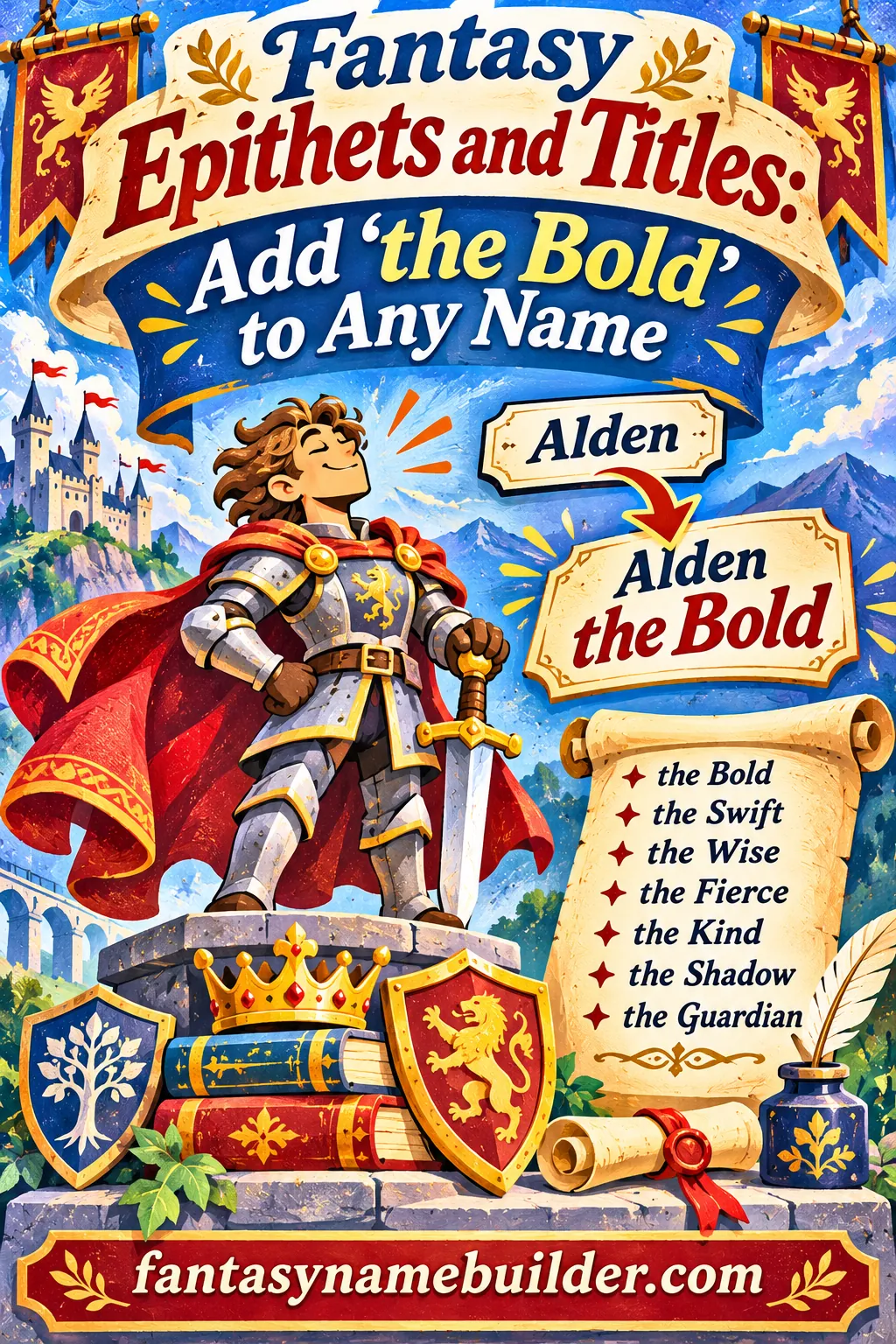
To give a plain fantasy name instant history, add an epithet in one of three forms: "the" plus a single word (Maren the Unyielding), a fused compound byname (Corwick Ashhand), or "of" plus a place (Ysolde of the Nine Wells). Each form tells the reader something different, so the trick is choosing the one that matches the story behind your character. Grab a base name from the free Fantasy Name Generator, then pick an epithet from the lists below.
A name like "Tamsin" is fine. "Tamsin the Twice-Drowned" is a character people ask questions about. That's the whole job of an epithet: it hints that something happened, that people talked about it, and that the name outgrew the person who first wore it.
Below you'll find more than 250 ready-to-use fantasy epithets sorted by form and mood, a table that matches titles to races and classes, exact steps for building base names in the generator, and a fix-it table for when a title just doesn't land.
⚔️ Pick a name from this list
Tap Next for a name from this page, and save the ones you love.
Why an Epithet Fixes a Name That Feels Flat
A first name tells you who someone is. An epithet tells you what other people think of them. That second layer is what makes a name feel like it belongs to a real person with a past.
In real medieval history, bynames were practical. Villages had five men named John, so one became John the Smith, another John Short, another John of the Mill. Kings got labels from their chroniclers: the Bold, the Fat, the Unready, the Good. Viking-age Scandinavians used vivid nicknames like Bloodaxe or Forkbeard. None of these were chosen for drama. They stuck because they were useful and true, or funny and unfair.
That's exactly why they work in fiction and tabletop games. An epithet does three jobs at once:
- It separates characters. If your party meets two blacksmiths, "Odo the Elder" and "Odo Scorchbrow" never get confused.
- It implies a backstory without explaining it. "The Thrice-Crowned" makes readers wonder how a throne gets lost twice.
- It signals reputation. Heroes, villains and town drunks all earn titles, and the title tells you how the world sees them.
You don't need an epithet for every character. Save them for people with a reputation: rulers, legends, notorious villains, famous mercenaries, and player characters who've done enough to get talked about in taverns.
The Three Epithet Forms (and When to Use Each)
Almost every fantasy epithet falls into one of three shapes. Knowing which one you're using helps you choose words that sound right together.
| Form | Pattern | Example | Best for | What it suggests |
|---|---|---|---|---|
| "The" + word | Name the Adjective or Name the Noun | Maren the Unyielding | Rulers, heroes, legends | A reputation everyone agrees on |
| Compound byname | Name + two fused words | Corwick Ashhand | Warriors, outlaws, rough folk | A physical mark or a single famous deed |
| "Of" + place | Name of Place | Ysolde of the Nine Wells | Nobles, pilgrims, exiles | Where someone comes from or rules |
Form 1: "The" plus a word
This is the classic royal and heroic form. It can be an adjective (the Bold, the Silent, the Merciless) or a noun (the Lantern, the Hammer, the Wolf). Adjectives describe character. Nouns turn the person into a symbol, which feels a step more legendary.
You can also add a hyphenated adverb for extra weight: the Twice-Drowned, the Ever-Watchful, the Thrice-Crowned. Use these sparingly, because two of them in one cast starts to feel crowded.
Form 2: Compound bynames
Compound bynames fuse two short words into one: Ashhand, Grimwater, Quickcoin, Saltbeard. They sit in the surname slot, so they read like a family name that started as a nickname. They feel earthy and a little rough, which suits soldiers, sailors, outlaws, dwarves and orcs.
The most reliable recipe is body part, object or color + a second hard word. Keep each half to one or two syllables. "Ironjaw" works. "Mithrilescentshoulder" does not.
Form 3: "Of" plus a place
Place epithets are the oldest naming trick around. They make a character feel rooted, and they quietly build your map at the same time. "Pell of Lower Marrow" tells you a place called Lower Marrow exists, probably small and rural, and that Pell won't stop talking about it.
You can use a real settlement (of Ashford), a landmark (of the Nine Wells), a direction (of the North Road) or something poetic (of the Long Watch, of the Last Light). For more place-name raw material, the fantasy kingdom names list pairs well with this form.
250+ Fantasy Epithets You Can Use Today
Every epithet below is ready to attach to a name. Pick one, say the full name out loud, and see if it feels like someone people would gossip about.
Heroic and Noble "The" Epithets
- the Bold
- the Brave
- the Just
- the Wise
- the Steadfast
- the Unyielding
- the Unbroken
- the True
- the Fair
- the Generous
- the Lionhearted
- the Gallant
- the Faithful
- the Valiant
- the Patient
- the Merciful
- the Peacemaker
- the Lawgiver
- the Builder
- the Shepherd
- the Lantern
- the Shield
- the Beacon
- the Healer
- the Restorer
- the Liberator
- the Ever-Watchful
- the Promise-Keeper
- the Kind
- the Beloved
Dark, Feared and Villainous Epithets
- the Cruel
- the Merciless
- the Pitiless
- the Black
- the Hollow
- the Unforgiven
- the Cold
- the Butcher
- the Gravemaker
- the Ashmaker
- the Wolf
- the Viper
- the Hangman
- the Silent Knife
- the Faithless
- the Usurper
- the Oathbreaker
- the Plaguebringer
- the Pale
- the Nameless
- the Bloodless
- the Withered
- the Smiler
- the Collector
- the Dread
When you're building a full antagonist, the villain names list gives you base names that already carry some menace, so the epithet doesn't have to do all the work.
Physical and Appearance Epithets
- the Tall
- the Short
- the Stout
- the Lean
- the Red
- the Fair-Haired
- the One-Eyed
- the Scarred
- the Lame
- the Gray
- the Bald
- the Broad
- the Crooked
- the Pale-Eyed
- the Handsome
- the Giant
- the Small
- the Left-Handed
- the Silver-Tongued
- the Iron-Jawed
Physical epithets are the most realistic kind. They're also great for ordinary people in your world, the innkeepers, guards and merchants who'd never earn a heroic title but still need to be told apart.
Deed and Event Epithets
- the Twice-Drowned
- the Thrice-Crowned
- the Dragon-Touched
- the Bridge-Holder
- the Last Standing
- the Returned
- the Exile
- the Wanderer
- the Pilgrim
- the Oath-Sworn
- the Pardoned
- the Unburied
- the Gate-Breaker
- the Ten-Year Siege
- the Survivor
- the Ransomed
- the Wall-Climber
- the Firewalker
- the Long-Lost
- the Sleeper
Deed epithets are the best for player characters, because the table gets to invent them. When a rogue spends a whole session dangling from a tower, "the Wall-Climber" is born.
Nature, Beast and Weather Epithets
- the Stag
- the Bear
- the Hawk
- the Raven
- the Fox
- the Boar
- the Owl
- the Storm
- the Frost
- the Thunder
- the Rain-Walker
- the Oak
- the Thorn
- the River
- the Moth
- the Gale
- the Mountain
- the Flame
- the Ember
- the Tide
Wry, Ironic and Humorous Epithets
Real history is full of unflattering bynames, and they're a wonderful way to make your world feel less polished.
- the Unready
- the Lesser
- the Late
- the Mild
- the Loud
- the Lucky
- the Unlucky
- the Hungry
- the Sleepy
- the Fat
- the Forgetful
- the Almost-Great
- the Brief
- the Lost Again
- the Quarrelsome
- the Barefoot
- the Thrifty
- the Overdue
- the Optimist
- the Talkative
Ironic epithets work best when the name contradicts the person. A huge, gentle warrior called "Rook the Mild" or a famously brave knight nicknamed "the Late" because he once missed a battle gives your players something to laugh about and remember.
Compound Bynames (Fused Surname-Style Epithets)
These sit where a surname would go: Corwick Ashhand, Torvald Saltbeard. Many sound like they could have started as a nickname three generations ago and simply stuck to the family.
Body and appearance compounds
- Ashhand
- Saltbeard
- Ironjaw
- Grayhand
- Redbrow
- Scorchbrow
- Stonefist
- Crookback
- Coldeye
- Thinblood
- Longstride
- Blackthumb
- Brightbrow
- Splitlip
- Hollowcheek
Weapon and battle compounds
- Bloodaxe
- Cleavehelm
- Spearbreaker
- Shieldsplitter
- Hammerfall
- Bowstring
- Ravenspear
- Gatesmasher
- Redblade
- Wallbreaker
- Arrowtongue
- Knotsword
- Splinterlance
- Helmcrack
- Steelsong
Trade, money and daily-life compounds
- Quickcoin
- Tallowmaker
- Inkfinger
- Saltpurse
- Lampwright
- Ropewise
- Bellringer
- Coalhand
- Breadwell
- Ledgerkeep
- Mudboots
- Thatchwright
- Copperpenny
- Netmender
- Keykeeper
Dark and grim compounds
- Grimwater
- Gallowsong
- Ashgrave
- Bonepicker
- Duskblade
- Hollowmarch
- Gravewind
- Nightbloom
- Mournhelm
- Rotroot
- Ravenhallow
- Blackwake
- Cinderfall
- Woundweaver
- Duskmourn
Nature and weather compounds
- Stormcall
- Frostmantle
- Thornwalk
- Mosscloak
- Rainmarch
- Oakhollow
- Fernstep
- Hailbrow
- Squallborn
- Brackenfoot
- Highmoor
- Larkspur
- Tidewalker
- Ashwillow
- Snowmantle
If you'd rather have a proper inherited surname than a nickname, the fantasy last names list has plenty that already sound like old compound bynames, and dwarf players in particular can borrow from dwarf clan names.
"Of" Place Epithets
Each of these works as "Name of ___." Swap in your own settlements whenever you can, because place epithets are a free way to fill out your map.
Towns and holdings
- of Ashford
- of Lower Marrow
- of Wrenfield
- of Graywater Hold
- of Kestrel Bridge
- of Hollin Cross
- of Mirefield
- of Brannock Vale
- of Thistledown
- of Cold Harbor
- of Elmstead
- of Saltmere
- of Vellan's Reach
- of the Twin Mills
- of Hob's End
Landmarks and wild places
- of the Nine Wells
- of the Black Fen
- of the Shattered Coast
- of the Long Watch
- of the Hollow Hills
- of the Red Pass
- of the Weeping Falls
- of the Thousand Steps
- of the Drowned Forest
- of the Ninth Tower
- of the White Road
- of the Salt Flats
- of the Burning Isles
- of the Lonely Lighthouse
- of the Seven Bridges
Poetic and mysterious
- of the Last Light
- of No Fixed Hall
- of the Quiet Hour
- of the Unwritten Page
- of the Second Dawn
- of the Ash Years
- of the Turning Stair
- of the Empty Throne
- of the Far Bell
- of the Lantern Road
Notice how "of the Empty Throne" suggests a lost kingdom without saying a word about it, and "of No Fixed Hall" quietly tells you this person is a wanderer. Poetic place epithets are ideal for mysterious strangers, oracles and exiled royalty.
Formal Titles You Can Stack With an Epithet
Sometimes you want rank as well as reputation. Put the formal title in front and the epithet behind: "Lady Ysolde of the Nine Wells" or "Captain Torvald Saltbeard."
- Lord / Lady
- Ser / Dame
- Captain
- Warden
- Marshal
- High Priestess / High Priest
- Archmage
- Elder
- Thane
- Magistrate
- Steward
- Reeve
- Margrave
- Abbess / Abbot
- Grandmaster
Two quick rules for stacking: keep the total to six syllables or so before the epithet starts, and don't pair a grand title with a grand epithet. "High Warden Lord Vaskar the Thrice-Crowned of the Ninth Tower" is a mouthful no one will ever say at the table. "Warden Vaskar the Thrice-Crowned" is plenty.
How to Make It in the Free Tool
The generator gives you base names. You add the epithet. Here's the exact process that works best.
Step-by-step settings
- Open the Fantasy Name Generator on the homepage.
- Race: Choose the race of your character. If you're unsure, leave it on All Races, or tap Browse All Races to see every option.
- Gender: Pick Male, Female, Neutral or Any.
- Length: Choose Short if you plan to add a long epithet like "of the Thousand Steps." Choose Long if your epithet will be a short single word like "the Bold."
- Format: Choose First only if you're adding a "the" epithet or an "of" place epithet. Choose Full name if you want a surname too and will add a formal title in front.
- Tap Generate ✦.
- Use ‹ › to page through results until a few names catch your eye.
- Tap ♡ on each name you like so it lands in your Saved list.
- When you have a shortlist, use ⬇ Export .txt to download it. Paste the list into your notes and write an epithet beside each one.
Which format setting fits which epithet form
| Epithet form | Format setting | Length setting | Example result |
|---|---|---|---|
| "The" + adjective | First only | Long | Aldreth the Patient |
| "The" + noun | First only | Short | Kev the Lantern |
| Compound byname as surname | First only | Short or Long | Mirela Quickcoin |
| "Of" + place | First only | Short | Ilse of the Red Pass |
| Title + full name + epithet | Full name | Short | Dame Orla Vance the Steadfast |
| Surname-style only (NPC families) | Surname only | Short | Hollin Gravewind (paired by hand) |
The Surname only format is handy for a different trick: generate ten surnames, then decide which family earned a byname over the years. Maybe the Thatchers became the Thatchwrights after a grandfather rebuilt half the village roofs after a storm.
A quick test before you commit
Say the whole name out loud three times, fast. If you stumble, shorten something. Many great base names get spoiled by an epithet that adds too many syllables or repeats the same sound. "Garran the Grim" alliterates nicely. "Garran Grimgrave the Grievous" is too many G's for anyone's mouth.
Matching Epithets to Race and Class
Different peoples in a fantasy world would hand out different kinds of titles. A long-lived elven court and a rowdy orc warband shouldn't name their heroes the same way. This table gives you a starting point.
| Race or class | Favorite form | Tone | Sample epithets |
|---|---|---|---|
| Elves | "Of" place, poetic "the" noun | Graceful, ancient | of the Second Dawn, the Moth, the Ever-Watchful |
| Dwarves | Compound byname | Proud, craft-focused | Stonefist, Hammerfall, Ledgerkeep |
| Orcs and half-orcs | Compound byname, blunt deed | Fierce, earned in battle | Helmcrack, Splitlip, the Gate-Breaker |
| Humans | All three forms | Varies by region and class | the Just, Quickcoin, of Ashford |
| Halflings and gnomes | Wry "the" word, trade compound | Cozy, funny, practical | the Hungry, Breadwell, the Optimist |
| Tieflings and dark-touched folk | Dark "the" word, grim compound | Mysterious, defiant | the Unforgiven, Duskmourn, of No Fixed Hall |
| Warriors and knights | Deed or heroic "the" | Honored | the Bridge-Holder, the Valiant, Shieldsplitter |
| Wizards and scholars | "The" noun, poetic place | Learned, a little odd | the Lantern, of the Unwritten Page, Inkfinger |
| Rogues and thieves | Compound byname, ironic | Street nickname | Quickcoin, the Wall-Climber, the Smiler |
| Rulers | "The" adjective | Chronicle style | the Unyielding, the Lawgiver, the Unready |
These aren't hard rules. An elf who grew up among dwarves might proudly carry "Stonefist," and that mismatch is itself a story. For the fighting side of the table, the warrior names list gives you strong base names that pair naturally with deed epithets.
Making the Title Feel Like It Has History
An epithet feels real when you know who started using it and why. Before you lock one in, answer three quick questions.
1. Who gave the title?
- The common folk usually give short, physical or affectionate names: the Red, the Kind, Mudboots.
- Chroniclers and court historians give formal adjectives: the Just, the Lawgiver, the Cruel.
- Enemies give insulting or fearful names: the Butcher, the Faithless, Crookback.
- The character themselves may pick something grand, which says a lot about their ego: "Call me the Storm."
That last one is great for villains and vain nobles. Everyone else in the world can quietly use a less flattering version behind their back.
2. Is the title true?
Some of the best epithets are wrong. "The Merciful" might have spared one city to look good while burning three others. "The Lucky" might have actually planned every escape. A title that hides the truth is a mystery your readers or players can uncover.
3. Has it changed over time?
Titles drift. A young prince known as "the Fair" might become "the Gray" after a long reign and "the Restorer" in history books after his death. You can show the passage of time just by having different characters call the same person by different epithets.
Five scenarios, start to finish
A tabletop hero after a big moment. Your half-orc fighter held a narrow bridge while the party escaped. Base name from the generator: Grusha. The table votes on an epithet: "the Bridge-Holder." Three sessions later, an innkeeper who heard the story secondhand calls her "Grusha Bridgebreaker," which is wrong, and that's even better.
A novel's fallen king. You need a ruler who lost and regained a throne. Generate a Long, Male, First only human name: Vaskar. Add "the Thrice-Crowned." Now the history of your kingdom has three wars baked into one name.
A mysterious stranger. Generate a Neutral, Short name: Ilse. Add a poetic place: "of the Empty Throne." Your reader immediately wonders which throne, why it's empty, and why this person claims it.
A village full of NPCs. Use Surname only to generate a dozen family names, then give four of the families trade compounds instead (Netmender, Bellringer, Coalhand, Breadwell). The village now has a working economy written into its names.
A comic sidekick. Generate a Short halfling name: Pip. Give him "the Overdue." Every time he arrives late, the joke lands, and if he's ever early in a crisis, that's a story moment.
Using the epithet in dialogue and prose
Once a character has a title, how often should you use it? Less than you might think. An epithet is strongest when it shows up at the right moments instead of in every line.
Introduce it once, with weight. The first time readers or players meet the character, give the full name and title together, ideally from someone else's mouth: "That's Neve of the Long Watch. Forty winters on that tower and she's never once asked for relief." The speaker does the explaining, so you don't need a paragraph of backstory.
Then drop to the short name. After the introduction, call her Neve. Bring the title back when it matters: when she's announced at court, when an enemy wants to sound respectful or mocking, or when someone tells her story to a stranger.
Let different speakers use different versions. A noble might say "Lady Ysolde of the Nine Wells." Her old nurse says "Ysolde." A rival says "the well-girl." Each version tells you about the speaker as much as about Ysolde.
Use it as a scene tool at the table. Game masters can use epithets to make NPCs instantly memorable. When the party asks the innkeeper for directions, "Ask Hob Mudboots at the stable" is far easier to remember than "Ask Hob at the stable." Players will repeat it, joke about it, and come back to that stable just to see him.
Change it when the character changes. If your character grows, consider letting the title grow too. A thief once called "the Smiler" by street kids might become "the Smiler of the Docks" after taking over a gang, and then simply "the Smiler," spoken quietly, once the whole city fears her. Tracking those shifts across a story or campaign is a satisfying way to show progress without saying it.
Watch the rhythm in sentences. Long epithets can clog a paragraph. If you need to use one mid-sentence, set it off with commas or let it end the sentence so the reader can breathe: "Behind the gate waited Vaskar the Thrice-Crowned." That sentence lands. "Vaskar the Thrice-Crowned's guards drew their swords" is clumsy, so rephrase it as "The guards of Vaskar the Thrice-Crowned drew their swords."
Troubleshooting: When the Epithet Doesn't Work
| Problem | Why it happens | Fix |
|---|---|---|
| Name feels too long | Base name plus epithet runs past nine syllables | Switch the generator to Short length or use a one-word epithet |
| Sounds like a parody | Too many grand words stacked together | Drop the formal title or the place, keep one strong element |
| Too close to a famous character | Common words like "Dragon" or "Storm" plus a popular name | Change one half; swap the noun for a less common one (Gale, Squall, Thunder) |
| Every character has an epithet | Titles used as decoration, not reputation | Keep epithets for about one in five named characters |
| Epithet and name clash in sound | Harsh name plus a soft, dreamy epithet, or the reverse | Match the tone: harsh with hard compounds, soft with poetic "of" places |
| Players forget the base name | The epithet is more fun to say | Lean into it; let the epithet become the character's common name |
| Epithet spoils a twist | "The Traitor" reveals the plot too early | Use a misleading or ironic title, then reveal the truth later |
| Same sound repeated | Alliteration overdone (Grim Garran Gravegrip) | Keep alliteration to two words at most |
Common mistakes to avoid
Picking a title before you know the story. An epithet should come from something. If you can't say in one sentence why someone is "the Patient," pick a simpler one or invent the reason first.
Making every title heroic. A world where everyone is "the Brave" or "the Mighty" feels flat. Mix in physical, ironic and trade epithets so your heroes stand out against ordinary people.
Forgetting the grammar. In English, "the" epithets follow the name: "Maren the Unyielding," not "the Unyielding Maren" (unless a bard is being poetic). Compound bynames sit in the surname slot. Place epithets use "of," and you'll want "the" before most landmarks: "of the Red Pass," but just "of Ashford" for a town.
Capitalization slips. Capitalize the main word of the epithet and leave "the" and "of" lowercase in the middle of a name: Ondrel the Patient, Neve of the Long Watch.
Copying a famous title. Some epithets are so tied to well-known books and shows that readers will think of them first. If an epithet instantly reminds you of a specific character, keep looking. The lists above were written to steer clear of that.
Ready-Made Name and Epithet Pairs
Need something you can drop straight into a story or campaign? Here are complete, original pairings sorted by role. Each one pairs a base name you could get from the generator with an epithet that suggests a history.
Rulers and nobles
- Queen Aveline the Lawgiver
- King Osric the Unready
- Lady Ysolde of the Nine Wells
- Margrave Tolan the Cold
- Duke Benedek of the Seven Bridges
Heroes and adventurers
- Maren the Unyielding
- Grusha the Bridge-Holder
- Tamsin the Twice-Drowned
- Kaelen Stormcall
- Rook the Mild
Villains and rivals
- Sorrel the Smiler
- Vharan Ashgrave
- Mother Ilka the Collector
- Draven of the Empty Throne
- Brother Caius the Faithless
Ordinary folk with a reputation
- Lirra Quickcoin, merchant
- Hob Mudboots, stable hand
- Old Wenna Breadwell, baker
- Ansel Inkfinger, scribe
- Pell of Lower Marrow, farmhand
Make Your Own Titled Names Now
Start with a great base name, then let the epithet tell the story. Head to the free Fantasy Name Generator, set your race and gender, choose First only with Short length for long epithets, tap Generate ✦, save the best with ♡, and export your shortlist. Then come back here and give each one a title people would whisper about in taverns.
Frequently Asked Questions
What is a fantasy epithet?
A fantasy epithet is a descriptive title added to a character's name, like "the Bold," "Ashhand" or "of the Nine Wells." It hints at the character's reputation, appearance, deeds or home. Epithets make names feel older and more storied.
What's the difference between an epithet and a surname?
A surname is inherited and usually says which family you belong to. An epithet is earned or given and says something about you personally. Over generations, though, a catchy epithet can turn into a family surname, which is how many compound bynames are born.
How do I choose the right epithet for my character?
Start with one fact about your character: a famous deed, a striking feature, a home or a personality trait. Then pick the form that fits: "the" for reputation, a compound for a physical mark or rough nickname, and "of" for a home or origin. Say it out loud to check the rhythm.
Can a character have more than one epithet?
Yes, and it can be a lovely detail. Different groups might call the same person different things: the court says "the Just," the rebels say "the Cruel." Just use one at a time in any single line of dialogue or narration.
Should player characters choose their own epithets?
They can, but many tables find it more fun when epithets are earned in play. A dramatic moment or a running joke often produces a better title than anything chosen at character creation. Some groups let the player pick from two or three options the table suggests.
Are epithets like "the Bold" and "Bloodaxe" free to use?
Simple words like "the Bold" or "the Wise" are ordinary English and were used for real historical figures, so anyone can use them. Real-world historical bynames like Bloodaxe are part of history too. Just avoid lifting an exact, distinctive title from a modern book, film or game.
How long should a name with an epithet be?
Aim for six to nine syllables total, including the epithet. If your base name is long, pick a short one-word epithet. If you want a long poetic "of" title, use a short base name.
Do epithets work for places and objects too?
They do. Swords, ships and even cities can carry them: a blade called "the Patient," a ship nicknamed "the Late," a city known as "the Gray." The same three forms and the same tone-matching rules apply.