Your Fantasy Character Names All Sound the Same: How to Make Them Distinct
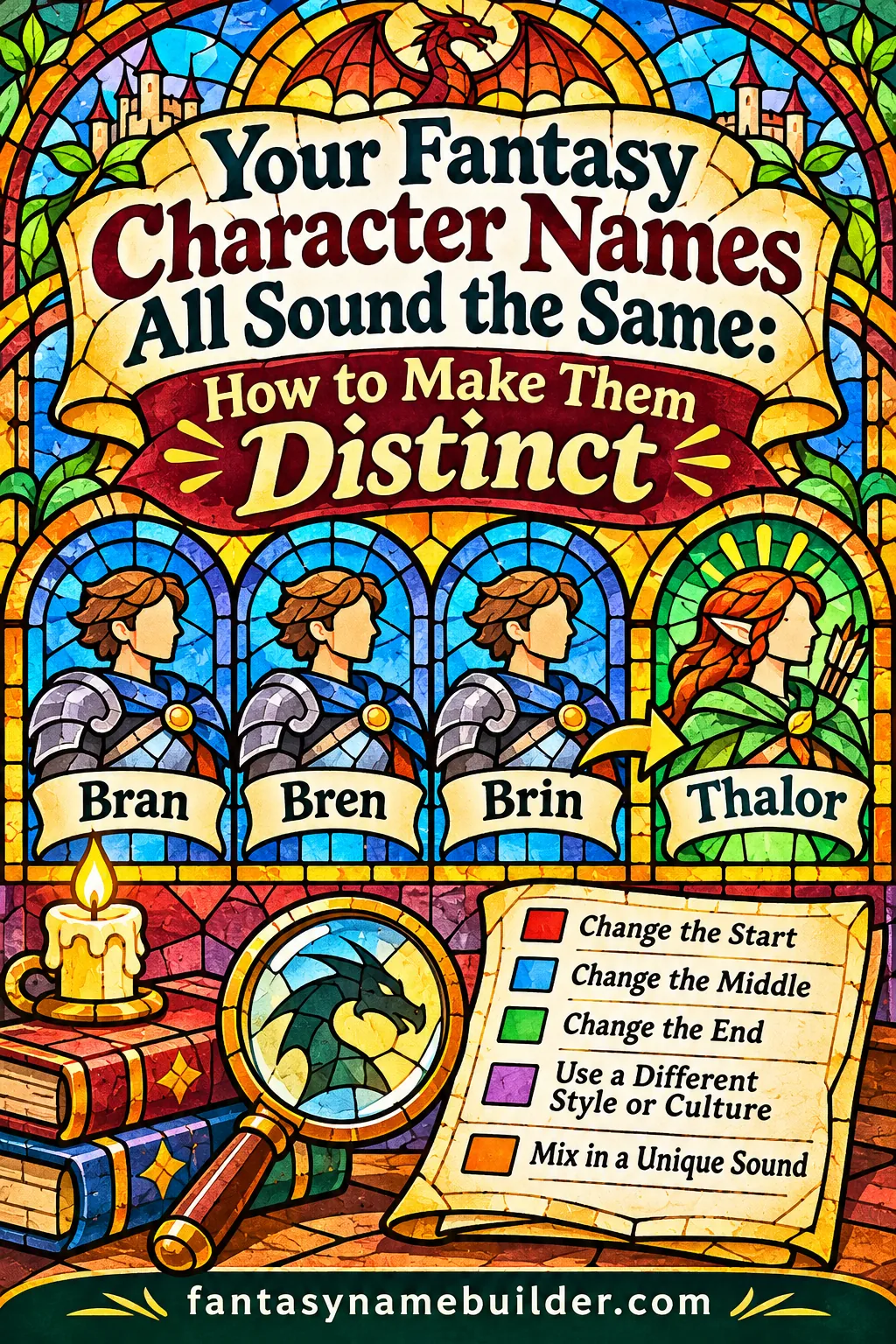
If your fantasy character names are too similar, give every major character a different first letter, a different number of syllables and a different ending sound, and let each culture in your world have its own sound palette. Those three checks catch nearly every "wait, which one is Bren?" problem before a reader or player ever sees it.
The quickest way to get fresh, varied names is the free Fantasy Name Generator on our homepage: pick a different race for each culture, generate a batch, and swap in a name that breaks the pattern. Below you'll find a five-minute cast audit, before-and-after fixes for every kind of sameness, sound palettes by race, exact generator settings, several ready-made casts with no clashing names, and a troubleshooting table for the stubborn cases.
⚔️ Pick a name from this list
Tap Next for a name from this page, and save the ones you love.
Why Similar Names Confuse Readers and Players
Here's something many writers don't realize: most people don't read names letter by letter. They recognize a name by its overall shape, mainly the first letter, the length and maybe the ending. When two names share those features, the brain files them in the same slot.
That's why a cast with Bran, Bren and Brin is so hard to follow. Each name is perfectly fine on its own. Together, they blur into one character with three moods. The same thing happens with less obvious pairs, like Kaelen and Kaedor, or Mira and Mina, or Sorin and Torin. The letters are different, but the shape is the same.
Similar names cause real problems:
- Readers lose track of who did what. They flip back to check, get frustrated, or just stop caring which character is which.
- Important moments lose their punch. If readers aren't sure whether it was Elara or Elena who betrayed the hero, the twist falls flat.
- Players at the table mix up NPCs. In a tabletop game, there's no page to flip back to. If the quest-giver and the villain sound alike, players will confuse them for the rest of the campaign.
- Audiobook listeners and read-aloud audiences suffer most. When names are heard instead of seen, similar sounds are even harder to separate.
The fix isn't to find "better" names. It's to make sure each name looks and sounds different from every other name around it.
Why it happens in the first place
Almost every writer and game master falls into this trap at some point. A few common reasons:
- You have a favorite sound. Many people are drawn to the same letters again and again: soft L and R sounds, the letter K, names ending in -a or -an. You don't notice because each name feels new when you create it.
- You named characters weeks apart. The name you picked for chapter twelve doesn't feel like the one from chapter two because you've forgotten the earlier one.
- You built a culture with one strict sound. Giving elves soft, flowing names is great, until all twelve elves in your story sound like Aelindra.
- You used a single source. Pulling every name from one list or one style gives you a matching set, which is exactly what you don't want.
None of these is a failing. It's just how creative brains work. That's why a simple check at the end works better than trying to be careful at the start.
The Five-Minute Cast Audit
Before you rename anyone, find out exactly where the clashes are. This audit takes about five minutes and works for a novel, a short story, a campaign or a video game script.
Step 1: List every named character
Write down every character with a name, including minor ones who appear more than once. Don't forget places, ships, horses and gods if they're named often, because a city called Tarren will clash with a hero named Taren.
Step 2: Sort the list alphabetically
This is the single most useful step. When you alphabetize your cast, clusters jump out instantly. You'll see five names starting with K, three with M and none at all with F, G, O, P, U or W.
Step 3: Mark the five warning signs
Go through the sorted list and mark any pair that shares two or more of these features:
| Warning sign | What to look for | Example of a clash |
|---|---|---|
| Same first letter | Two main characters starting with the same letter | Kael and Kira |
| Same length | Same number of syllables and similar letter count | Torin and Davin |
| Same ending | Matching last syllable or last two letters | Elara, Lyra, Mara |
| Same vowel sound | Matching stressed vowel | Bran, Stan, Calan |
| Same shape | Same first letter and same ending, even if the middle differs | Seraphina and Sabrina |
One shared feature is usually fine. Two shared features between characters who appear in the same scenes is a problem worth fixing. Three is almost always a problem.
Step 4: Check who shares scenes
Names only need to be distinct from the names around them. If two characters live on opposite sides of the world and never meet, a little similarity won't hurt. But characters who share chapters, scenes or a party should look and sound completely different.
Step 5: Rank your fixes
Rename the less important character in each clashing pair. Your main character's name has probably settled into your story. The innkeeper who appears in two scenes is much easier to change.
A sample audit
Here's a real-looking cast list with the problems marked, so you can see how the audit works:
| Character | Role | Problem |
|---|---|---|
| Aelira | Elven heroine | Clashes with Aleira (same first letter, same ending, nearly same letters) |
| Aleira | Her sister | Rename |
| Brann | Dwarf warrior | Clashes with Bren (same first letter, same length) |
| Bren | Human thief | Rename |
| Kaedor | Villain | Clashes with Kaelen (same start) |
| Kaelen | Love interest | Rename one of them |
| Mira | Mentor | Clashes with Lyra (same ending, same length) |
| Lyra | Healer | Rename |
| Thorn | Ranger | No clash |
After the audit, this cast needs four renames. That sounds like a lot, but each one takes only a minute once you know what to aim for.
How to Fix Each Kind of Sameness
Once you know which names clash, change the feature that's causing the problem. You don't need to throw the whole name away. Often one change is enough.
Vary the first letter
This is the strongest fix, because the first letter is what readers notice first. Aim for each main character to start with a different letter, and try not to let any one letter cover more than two named characters in the same story.
Look especially at the letters writers forget about. Most fantasy casts overuse A, E, K, L, M, S and T. Far fewer use B, D, F, G, H, I, J, N, O, P, U, V, W or Y. Starting a name with an underused letter is an easy way to make it stand out.
| Overused start | Try instead | Example swap |
|---|---|---|
| K (Kael, Kira, Kaedor) | G, H or V | Kaedor becomes Vossen |
| A and E (Aelira, Elara) | O, U or I | Aleira becomes Odessa |
| M and L (Mira, Lyra) | F, P or W | Lyra becomes Pell |
| S and T (Sorin, Torin) | B, D or J | Torin becomes Jessup |
Vary the length
If two characters share a first letter for a good reason, change how long their names are. A one-syllable name and a four-syllable name almost never get confused, even when they start the same way. Brann and Bellamira can share a page without trouble.
A balanced cast mixes short, medium and long names. Something like this works well:
- One syllable: Krag, Pell, Wren, Dov, Ash
- Two syllables: Juno, Haldor, Fiora, Edmer
- Three syllables: Odessa, Ilvaren, Thessaly, Calloway
- Four or more: Bellamira, Seraphine, Aurelian, Evangeline
If your list is mostly two-syllable names, that alone might be why they blur together.
Vary the ending
Endings matter more than you'd think, especially when names are spoken. If half your female characters end in -a and half your male characters end in -an or -on, the whole cast starts to rhyme.
Try mixing in endings you haven't used yet:
| Common ending | Fresh alternatives |
|---|---|
| -a (Elara, Mira, Lyra) | -e, -is, -eth, -wyn, -elle, -ow, -ine |
| -an, -en, -in (Kaelen, Torin) | -ard, -ric, -mund, -ock, -ix, -ald, -er |
| -iel, -ael | -oth, -ast, -uen, -ery |
| -or (Kaedor, Thor-) | -um, -ish, -ance, -ley |
Vary the vowel sound
Even with different letters, names that share their main vowel sound can blur when read aloud. Bran, Stan and Calan all lean on the same short "a" sound. Try giving each name in a group a different stressed vowel: Bran, Pell, Dov, Juno, Wick.
Vary the shape
Some names look alike even when the sounds differ, because of double letters, apostrophes or similar silhouettes. Two names full of tall letters, like Thalldir and Tholdrik, can look alike on the page. Pair a name like that with something rounder, such as Oona or Merrow, and the difference is obvious at a glance.
Before and after: full cast fixes
Here's the sample cast from the audit after a round of fixes:
| Before | After | What changed |
|---|---|---|
| Aelira and Aleira | Aelira and Odessa | New first letter, new ending |
| Brann and Bren | Brann and Juno | New letter, new length, new vowel |
| Kaedor and Kaelen | Vossen and Kaelen | Villain gets a new first letter and harder sound |
| Mira and Lyra | Mira and Pell | Pell is shorter, starts with P, ends in a consonant |
| Thorn | Thorn | No change needed |
Notice that the main characters kept their names. Only the supporting characters changed, and each change targeted exactly what was causing the clash.
Give Each Culture Its Own Sound Palette
The biggest long-term fix is to stop pulling every name from the same sound bank. If your elves, dwarves, humans and orcs each have their own way of building names, a reader can tell a character's background, and tell characters apart, at a glance.
A sound palette is just a short set of rules: favorite letters, common syllables, typical lengths and typical endings. Here's a starting set for classic fantasy peoples. Adjust any of them to fit your world.
| People | Favorite sounds | Typical length | Typical endings | Sample names |
|---|---|---|---|---|
| Elves | L, R, TH, soft S, many vowels | Long, three or more syllables | -iel, -wen, -aren, -ith, -esse | Ilvaren, Thessaly, Saelorne, Faerith |
| Dwarves | Hard K, G, D, R, double consonants | Short, one or two syllables | -in, -ek, -und, -grim, -a | Gorvund, Ulma, Dagrik, Brann |
| Humans | Familiar, mixed, everyday sounds | Two syllables, sometimes plain one | -ric, -ard, -ley, -wyn, -e | Edmer, Aldwin, Juno, Calloway |
| Halflings | Rounded, cheerful, B, P, M | Short first name, long cozy surname | -o, -y, -kin, -bottom, -hock | Pim Hollyhock, Bo Pennyfoot |
| Orcs and half-orcs | Guttural G, R, K, Z, clipped | Short, one or two syllables | -ash, -uk, -ok, -a | Krag, Zekh, Graith, Ruska |
| Gnomes | Bouncy, playful, repeated sounds | Long and quirky | -wick, -ble, -nik, -o | Fizzlenik, Bimlo Quillwick |
| Dragons | Grand, rolling, R, X, TH, V | Long and formal | -rax, -thos, -orath, -ix | Vaelorath, Ixtheris |
| Fae | Light, airy, F, L, Y, sometimes nature words | Varies; often one striking word | -elle, -ia, -ys, -een | Ysmeen, Fiora, Thistle |
Once each people has its own palette, clashes between cultures almost disappear. An elf named Ilvaren and a dwarf named Ulma will never be mistaken for each other. The trick is to watch for sameness inside each culture, which brings us back to the audit: an elven court where everyone is named Ael-something will still blur. Inside a culture, vary the first letter and length while keeping the overall feel.
For deeper name lists by people, the elf names and dwarf names pages each show the sound patterns of that people with many examples, and the fantasy character names page mixes styles across races and classes.
Let surnames help
Surnames are another place to add variety. If you're stuck with two characters who both need to start with the same letter, give them very different family names. Kaelen Ashdown and Kira Velloway are easier to separate than Kaelen and Kira alone, especially if the story sometimes uses surnames.
Different cultures can also handle surnames differently. Humans might use place or job names (Calloway, Pease), dwarves might use clan names (Ironvein, Stoneshield), elves might use descriptive names (Moonvale, Silverleaf), and orcs might use earned titles (Bonejaw, the Red). That difference adds variety for free. The fantasy last names page has plenty of surname ideas sorted by style.
How to Make It in the Free Tool: Exact Settings
The Fantasy Name Generator makes the renaming step fast, because you can see dozens of options for each culture in a minute or two. Here's a method built for fixing a cast that sounds too alike.
Settings for replacement names
| Setting | What to choose | Why it helps |
|---|---|---|
| Race | The people the character belongs to, or "Browse All Races" to see every option | Keeps the new name inside that culture's sound palette |
| Gender | Match the character, or choose Neutral or Any for more variety | Neutral and Any often give you sounds you wouldn't pick yourself |
| Length | The opposite of the name it clashes with | If the clash is between two short names, choose Long, and the reverse |
| Format | First only while renaming; Full name when you want a surname too | First names are where most clashes happen |
| Generate ✦ | Click, then page through results with ‹ › | Lets you scan many names quickly for an unused first letter |
| ♡ | Save every candidate that starts with a letter your cast doesn't use yet | Builds a shortlist in your Saved list |
| ⬇ Export .txt | Download the shortlist | Lets you compare candidates next to your cast list |
The step-by-step routine
- Keep your alphabetized cast list open beside the generator.
- Note which first letters are already taken and which are free.
- Set Race to the character's people and Length to the opposite of the clashing name.
- Click Generate ✦ and page through with ‹ ›.
- Skip any name that starts with a taken letter or shares an ending with a nearby character.
- Tap ♡ on every name that passes. Aim for five to ten candidates.
- Say each saved name aloud next to the names of the characters it shares scenes with.
- Pick the one that sounds most different, then export your Saved list with ⬇ Export .txt so the runners-up are ready for future characters.
That last point matters. The names you didn't choose are a ready-made bank of distinct names for the next time you need someone new.
Building a new cast from scratch
If you're starting a new story or campaign and want to avoid the problem entirely, use the generator to build your whole cast in one sitting:
- Generate names for each culture separately, switching the Race setting each time.
- Alternate between Short and Long lengths so the cast naturally has a mix.
- Save more names than you need, then alphabetize the Saved list before assigning anyone a name.
- Assign names so that no two major characters share a first letter.
Doing this once at the start saves hours of find-and-replace later.
Ready-Made Casts With No Clashing Names
Need a whole group right now? Each of these casts was built with different first letters, mixed lengths and varied endings, so every name stands apart. Use them as they are, or swap in your own names using the same pattern.
An adventuring party of six
| Name | Role | Why it stands out |
|---|---|---|
| Brann Coldhollow | Dwarf fighter | One heavy syllable, hard B |
| Ilvaren Sel | Elf wizard | Starts with a vowel, three syllables |
| Juno Pratt | Human rogue | Bright vowel, two short beats |
| Krag | Half-orc barbarian | One clipped syllable, no surname |
| Seraphine Dax | Tiefling bard | Long and musical, very short surname |
| Pim Hollyhock | Halfling cleric | Tiny first name, long cozy surname |
A royal court
| Name | Role | Why it stands out |
|---|---|---|
| Queen Aurelia Vane | Ruler | Long, regal, A start |
| Prince Dov | Heir | One syllable, rare D-O sound |
| Lord Halvard Grieve | Chancellor | Hard H and V, two syllables |
| Lady Thessaly Ormond | Spymaster | Th- start, three syllables |
| Sir Edmer Calloway | Captain of the guard | Old-fashioned E start |
| Wick | Court jester | One syllable, W start |
| Mother Yselle | High priestess | Rare Y, soft ending |
| Fennimore Gale | Royal tutor | F start, long first name |
A frontier village
| Name | Role | Why it stands out |
|---|---|---|
| Agnes Mallow | Innkeeper | Classic, two syllables |
| Bo Tansy | Stable hand | Very short |
| Corlis Hatch | Blacksmith | Hard C, consonant ending |
| Dulcie Rowe | Baker | Soft D, ends in -ie |
| Garret Vole | Hunter | G start, -et ending |
| Hesper Lune | Herbalist | H start, -er ending |
| Old Nim | Village elder | One syllable, nickname feel |
| Ulma Graith | Dwarven miner | U start, gruff sound |
A ship's crew
| Name | Role | Why it stands out |
|---|---|---|
| Captain Odalys Vire | Captain | O start, three syllables |
| Raskia Dunne | First mate | Sharp R and K |
| Tobiah Quell | Navigator | T start, -iah ending |
| Fiora Langstrand | Lookout | Open vowels, two-part surname |
| Mungo | Cook | M start, -o ending, no surname |
| Zekh Morrow | Deckhand | Rare Z, clipped |
| Ezra Pellingham | Ship's surgeon | E start, long surname |
A villain's inner circle
| Name | Role | Why it stands out |
|---|---|---|
| Vossen the Gray | Mastermind | V start, hard -ssen ending |
| Lady Cressida Nyle | Poisoner | Elegant, three syllables |
| Gorvund Ashk | Enforcer | Heavy dwarven sound |
| Nub | Goblin spy | One tiny syllable |
| Ysabet Quarrow | Sorceress | Rare Y and Q |
Notice that across each table, no two names share a first letter, and lengths range from one syllable to four. That's the whole recipe.
Special Cases: Siblings, Titles, Nicknames and Sequels
Some situations make similar names harder to avoid, or even desirable. Here's how to handle them.
When names are meant to match
Sometimes similarity is the point. Twins might have matching names, a royal family might reuse names across generations, and a culture might give siblings names that rhyme. That's fine, as long as you give readers another way to tell them apart.
- Give one a nickname. Twins named Aldric and Aldwin can become "Al" and "Win" in everyday speech.
- Use titles or roles. In a dynasty, "the old king" and "young Aldric" separate two characters with the same name.
- Add a number or epithet. Aldric the Second, Aldric Ironhand and Aldric the Kind are three different people at a glance.
- Keep them in different scenes. If two similar names never appear on the same page, they're far less likely to be mixed up.
Titles and epithets as tie-breakers
If you love two names too much to change either, lean on titles. "Captain Mira" and "Lyra the Healer" are easier to separate than Mira and Lyra. Use the title consistently, at least for the first few chapters or sessions, until readers have learned who's who.
Nicknames that collide
Watch out for nicknames that bring back the problem you fixed. If Bellamira goes by "Bel" and Brann's brother is called "Ben," you've created a new clash. Check nicknames in your audit the same way you check full names.
Places and objects count too
Readers don't separate character names from other proper nouns. A city called Kaelos, a sword called Kaelbane and a hero called Kaelen will all blur together. Run your place names, ship names, gods and famous weapons through the same audit.
Series and long campaigns
The longer your story runs, the more names pile up, and the more likely you are to repeat sounds without noticing. Keep a master name list for your whole series or campaign, sorted alphabetically, and check it every time you add someone new. A spreadsheet or simple text file is enough. Before you name a new character, check whether that first letter is already crowded.
Read-aloud and audio stories
If your story will be read aloud, as a bedtime story, at a gaming table, or in an audiobook, check how names sound, not just how they look. Names like Kael and Gale look different but sound almost the same out loud. Say every pair aloud, or have someone else read your list to you.
Troubleshooting: When Names Still Blur Together
Even after an audit, a few stubborn problems can remain. Use this table to diagnose them.
| Symptom | Likely cause | Fix |
|---|---|---|
| Beta readers still mix up two characters | Names share a shape, even with different letters | Change the length or ending of one, not just a letter |
| Every elf sounds the same | Sound palette is too narrow | Keep the culture's feel but vary first letters and lengths within it |
| The cast feels random and unconnected | Too much variety, no cultural logic | Give each people a palette, then vary inside it |
| Players remember the villain's lieutenant as the villain | Two names start alike | Give the lieutenant a one-syllable name or a nickname |
| A new character sounds like an old one | Named weeks apart without checking | Check your master list before naming anyone new |
| Readers can't pronounce a name | Too many consonants or apostrophes | Simplify the spelling; pick a cleaner option from the generator |
| You love both clashing names | Emotional attachment | Keep both but separate them with titles, nicknames or different scenes |
| The main character's name is the problem | Clashes with several minor characters | Rename the minor characters instead; they're easier to change |
A last check before you publish or play
Before you share your story or start your campaign, run through this short list:
- Alphabetize every named character, place and important object.
- Make sure no letter starts more than two major names.
- Check that lengths range from short to long.
- Look for repeated endings and repeated vowel sounds.
- Say every name aloud next to its scene partners.
- Check nicknames and titles for new clashes.
If everything passes, your readers or players will be able to follow your cast without a second thought. And if you need a quick replacement for any name that fails, open the free Fantasy Name Generator, set the race, and look for a name that starts with a letter you haven't used yet.
Frequently Asked Questions
What do I do if my fantasy character names are too similar?
Alphabetize your cast and look for names that share a first letter, length or ending. Rename the less important character in each clashing pair, changing the feature that causes the clash. A name generator set to that character's race makes it easy to find a distinct replacement.
Why do readers confuse character names?
Most people recognize names by their overall shape, mainly the first letter, length and ending, rather than reading every letter. When two names share that shape, readers tend to blend the characters together. This is even more common when names are heard instead of read.
Should every character have a different first letter?
For main characters, it's a very good rule. Minor characters can occasionally share a letter with someone, as long as their names differ in length and sound and they don't appear in the same scenes. The more important a character is, the more their name should stand alone.
How many characters can start with the same letter?
A good guideline is no more than two named characters per letter in a single story, and never two main characters. If a letter is crowded, move new names to underused letters like F, G, O, P, U, W or Y.
Is it okay for names in the same culture to sound alike?
Names from one culture should share a general feel, which helps world-building. But inside that culture, vary first letters, lengths and endings so individuals don't blur together. Think of it as a family resemblance, not identical twins.
How do I fix similar names in a finished manuscript?
Make a list of every clashing pair and decide which character to rename. Use find-and-replace carefully, checking each change so you don't alter other words that contain the same letters. Then read the affected chapters again to make sure the new name fits every scene.
Can a name generator help make names more distinct?
Yes. A generator lets you see many options for each culture quickly, so you can pick one that starts with an unused letter and has a different length. Saving several candidates and comparing them against your cast list makes the choice easy.
Do place names and character names need to be distinct from each other?
They do. Readers treat all proper nouns the same way, so a city called Tarren and a hero named Taren can easily be confused. Include places, ships, gods and named weapons in your name audit.